-
Cover Reveal: The Creeper – A.M. Shine
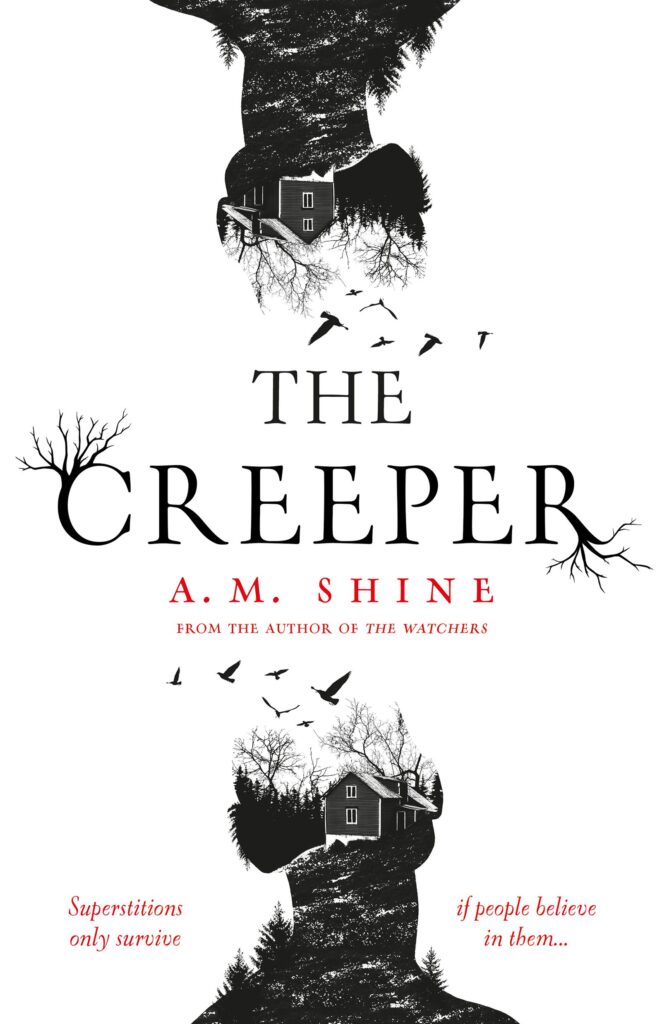
A.M. Shine captured the hearts of horror lovers in 2021 with his debut The Watchers (see my review of it here). And now Ireland’s newest scary darling is back with a new novel that sounds just as delightful and creepy… I’m thrilled to be part of the cover reveal for The Creeper, out on September 15th from Head of Zeus. You can pre-order a copy via Bookshop here (affiliate link), and read on for the blurb, to see the gorgeous cover and for an exclusive interview with the author.
Superstitions only survive if people believe in them…
Renowned academic Dr Sparling seeks help with his project on a remote Irish village. Historical researchers Ben and Chloe are thrilled to be chosen –until they arrive…
The village is isolated and forgotten. There is no record of its history, its stories. There is no friendliness from the locals, only wary looks and whispers. The villagers lock down their homes at sundown. A nameless fear stalks the streets…
Nobody will talk –nobody except one little girl. Her story strikes dread into the hearts of the newcomers. Three times you see him. Each night he comes closer…
That night, Ben and Chloe see a sinister figure watching them. He is the Creeper. He is the nameless fear in the night. Stories keep him alive. And nothing will keep him away…
Which was the first horror story you read that made you want to write in the same vein? (Was it another type of story that first made you want to write?)
It all began with a picture book for 3-5 year olds called Funny Bones by Janet and Allan Ahlberg. It follows a skeleton family with a skeleton dog,and though not officially a horror per se, it’s full of fleshless, reanimated corpses, all smiling as if they’re happier in death than they ever were in life.After that, I was a teenager, and the book was Lovecraft’s third omnibus – The Haunter of the Dark. My older brother borrowed it off a friend of his, and then fate found its way into my hands. Stories like “The Outsider” and “The Thing on the Doorstep” opened my eyes to a style of writing that I would read obsessively for over a decade. Had that book not crept into my house, I wonder how different my life would be now.
How has the landscape of Ireland inspired your work? Have you visited anywhere that particularly inspired The Creeper?
The landscape here is a character in its own right. Aside from those few days of sunshine in the summer, the west of Ireland is a beautifully bleak place. It’s a horror writer’s dream, if said horror writer likes their settings dark,damp, and dismally cold. Nothing stirs the literary mind quite like a good blast of horizontal rain. I walked many a wet woodland when I was writing The Watchers. And the village in The Creeper is actually based on the village I grew up in as a child. It’s a maze of narrow country lanes, with flooded fields, and ruined cottages. It certainly helps to capture the landscape on paper when you’ve stood there in person.
You have mentioned the influence of Poe and the Gothic horror tradition on your work. Has modern horror had any impact on your writing and if so, which authors/books?
The quality of writing and the originality of ideas are a constant source of inspiration and envy. They’re the reason the genre is so fresh and exciting in 2022. There’s such variety to the themes and characters that now, more than ever, readers who may have avoided horror for whatever reasons are being lured in. And it’s a trap, of course. Once we have them in that cage, they’re never getting out. To name but a few: Simone St.James blends horror and mystery together beautifully in the likes of The Broken Girls and The Sun Down Motel. Michelle Paver’s Dark Matter is a masterclass in isolation and possibly the coldest book I’ve ever read. Jonathan Aycliffe (one of my personal favourites) is a pro at the slow build, making sure that shiver hits the right spot on the spine; Naomi’s Room and The Lost, to name but two. I also adore writers who pay homage to any Gothic influencessuch as Nicole Willson’s Tidepool, which was one of my favourite books of last year. The list is endless.
How do you like to write? Do your plots come to you fully formed or do you start with a character or scenario and work from there?
A generous tumbler of absinthe during a full moon usually does the job. I think it’s crucial to understand what your ‘horror’ is, and then build the story around that. But coming up with something original is easier said than done. That involves a lot of staring into space. I’ll play around with characters, fears, scenarios and locations, and try to approach it from as many angles as possible. Often, the final plot is woven from many threads that could have been individual short stories in their own right. The Watchers was a rare exception in that I wrote Mina before the plot. I knew that I was sending her to the coop, but that’s all. Only when she was safely locked inside did I plan out the rest. With The Creeper, I had the plot and then designed the character of Ben to best complement the horror of the story.
How has Irish culture and tradition impacted your writing?
I’ve embraced my country’s culture in the same way I did with my baldness. Impacted? Yes. Any choice in the matter? Maybe some subtle cries. I owe so much to Ireland for providing me with the parts I need to assemble something fresh for the horror genre. Even our better-known folk tales are open for interpretation. Reworking and updating old horrors is a great way to keep them interesting, otherwise there’d be no surprises.This was the case with The Watchers, which was a reimagining of a very particular character in Irish folklore.And The Creeper toys with Ireland’s love affair with old superstitions and how they survive to this day. The horror at their core of both novels is quintessentially Irish. So, I count myself lucky to have been born on this little island and to be surrounded by so much spooky shit all the time.
Do you ever model your characters on yourself?
There are definitely a few personal traits and foibles that I’ve put into Mina (The Watchers) and Ben (The Creeper). But I’ll never tell you which ones. I’m like a parasite inside my characters that no one can see. I think every author puts bits of themselves into their work. But I’d also be guilty of “borrowing” personalities from people I know, mixing up whatever cocktail I need for the narrative.
Which other genres do you particularly like to read? Do they have an influence on your work?
I rarely stray too far from the horror genre. It’s become an addiction that I’m happy to live with. But science fiction and horror are so closely linked that often they’re one and the same. I still enjoy books grounded in reality but what I really look for are elements outside the ordinary – a concept or idea that I‘ve never encountered before. I really enjoyed Blake Crouch’s Pines trilogy. The twists, horror and pacing were sublime. Stuart Turton’s Seven Deaths of Evelyn Hardcastle was also wonderful. Applying a concept like body-swapping to a murder mystery was genius, and I’m in awe of how he managed to map it out. And the occasional thriller is always welcome, especially if they’re twisty. The last one I loved was The Silent Patient by Alex Michaelides.
If you weren’t writing horror what other literary projects would you like to pursue?
There’s only horror. Even if I tried my pen at sci-fi, it would always read like a horror. It’s both a blessing and a curse.
Which two of the following characters would you rather have dinner with: Carmilla, C. Auguste Dupin, Frankenstein’s monster, Count Dracula, Cthulhu, Roderick Usher?
Frankenstein’s monster – eloquent and an absolute gent. But would I enjoy my dinner sitting across from a mismatch of stitched together body parts? Probably not. Cthulhu – he’s a fair size, so I’ll put his invite aside until I’m having a summer barbeque. Dupin would probably talk too much, and poor old Roderick too little. So, I guess it’s got to be the Count and Carmilla. Vampires – good conversationalists, snappy dressers. With some bottles of wine and a few carafes of blood, we could quite happily natter by the fire until the dawn.
-
March Hype Post
Alas, it is already the end of the month again and time to go over the books and think about what we’d like you to think about putting on your March TBRs. Have a look over our choices in the yearly Megapost here, and then read through these additional books here – we’re sure you’ll find something that tickles your fancy! From the Megapost, I’d especially like to point out Lakelore by Anna-Marie McLemore – all of their books have been five-star reads for me, and even though I haven’t read this one yet I’m sure it will be fantastic too – and Travelers Along the Way by Aminah Mae Safi, the Robin Hood retelling of my dreams – set in the Holy Land, with a Muslim girl protagonist (see my review over at Grimdark Magazine here). The Bone Orchard by Sara A. Mueller is also one that will likely appeal to lots of readers here, I’ve been comping it as Gideon the Ninth meets Alix E. Harrow (review at Grimdark Magazine here).
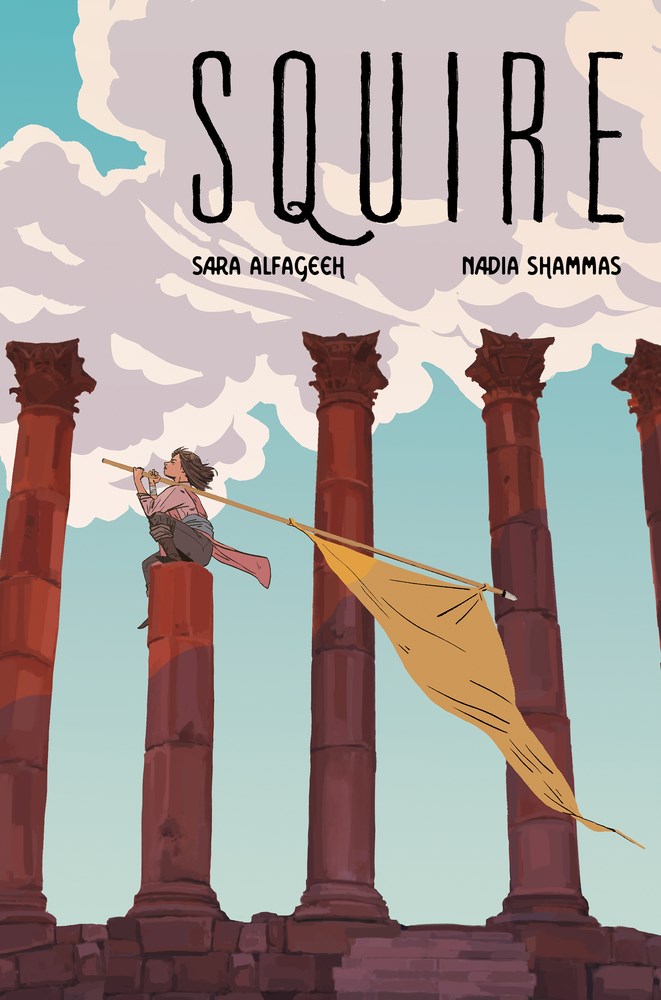
Squire by Sara Alfageeh and Nadia Shammas is a YA graphic novel out on March 8th. And we all know how much both graphic novels and knights are catnip for me… The blurb sounds super interesting, a new take on the usually westernised concept of knighthood – definitely one I’ll try to get my hands on very soon. Order a copy via Bookshop here (affiliate link) if the blurb below catches your attention too.
Aiza has always dreamt of becoming a Knight. It’s the highest military honor in the once-great Bayt-Sajji Empire, and as a member of the subjugated Ornu people, Knighthood is her only path to full citizenship. Ravaged by famine and mounting tensions, Bayt-Sajji finds itself on the brink of war once again, so Aiza can finally enlist in the competitive Squire training program.
It’s not how she imagined it, though. Aiza must navigate new friendships, rivalries, and rigorous training under the unyielding General Hende, all while hiding her Ornu background. As the pressure mounts, Aiza realizes that the “greater good” that Bayt-Sajji’s military promises might not include her, and that the recruits might be in greater danger than she ever imagined.
Aiza will have to choose, once and for all: loyalty to her heart and heritage, or loyalty to the Empire.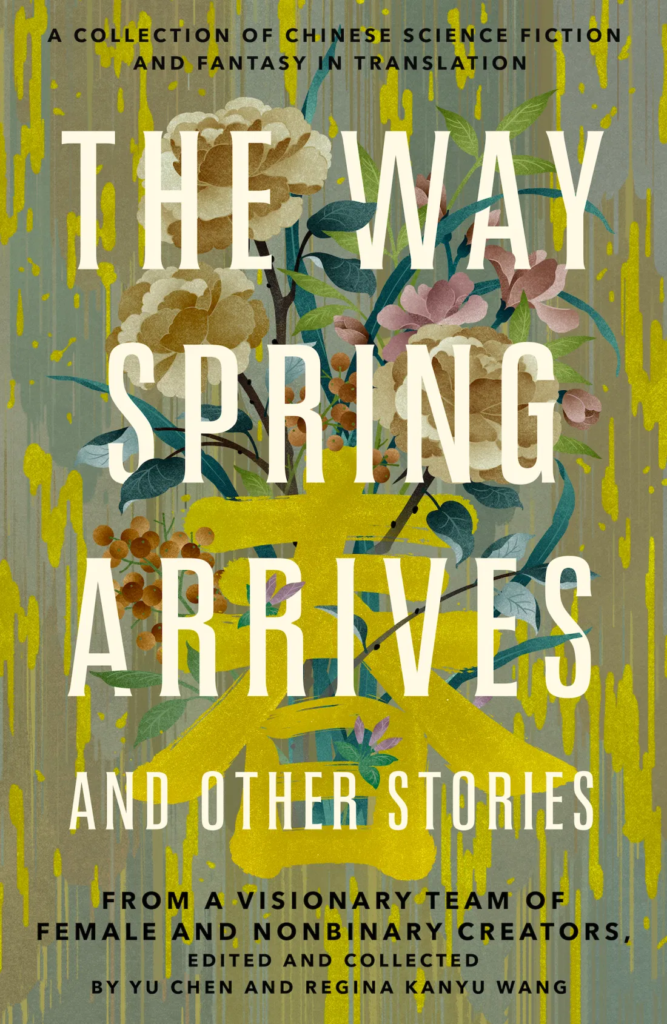
The Way Spring Arrives and Other Stories: A Collection of Chinese Science Fiction and Fantasy in Translation from a Visionary Team of Female and Nonbinary Creators, edited by Yu Chen and Regina Kanyu Wang is also out on March 8th. I’ve really been getting into Asian translated fiction in the past year or so, and adored Rebellion’s anthology Sinopticon (translated and edited by Xueting Christine Ni), so I’m especially excited about this anthology made up fully of contributions by women and non-binary authors, translators and editors. All of the stories included here have not been published in English before and give a great insight into the vivid culture of Chinese SFF past and present, preparing the Western audience for the Worldcon in Chengdu in 2023. From the blurb: “In The Way Spring Arrives and Other Stories, you can dine at a restaurant at the end of the universe, cultivate to immortality in the high mountains, watch roses perform Shakespeare, or arrive at the island of the gods on the backs of giant fish to ensure that the world can bloom.” I love discovering other culture’s approaches to storytelling, and I know I’m going to fall head over heels for this anthology when I get my hands on it. Order a copy from Book Depository here.
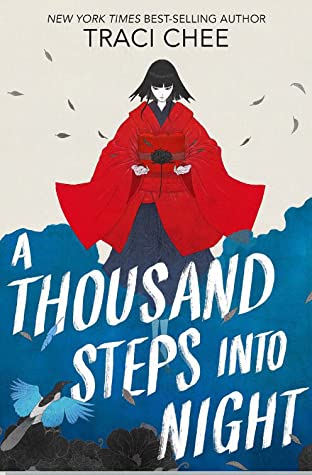
A Thousand Steps Into Night by Traci Chee is a YA fantasy out on the 1st of March. Inspired by Japanese legends, this is full of demons, adventure and plans gone wrong – and it sounds delightful. From the blurb: “In the realm of Awara, where gods, monsters, and humans exist side by side, Miuko is an ordinary girl resigned to a safe, if uneventful, existence as an innkeeper’s daughter. But when Miuko is cursed and begins to transform into a demon with a deadly touch, she embarks on a quest to reverse the curse and return to her normal life. Aided by a thieving magpie spirit and continuously thwarted by a demon prince, Miuko must outfox tricksters, escape demon hunters, and negotiate with feral gods if she wants to make it home again. But with her transformation comes power and freedom she never even dreamed of, and she’ll have to decide if saving her soul is worth trying to cram herself back into an ordinary life that no longer fits her… and perhaps never did.” Order a copy via Bookshop here (affiliate link).
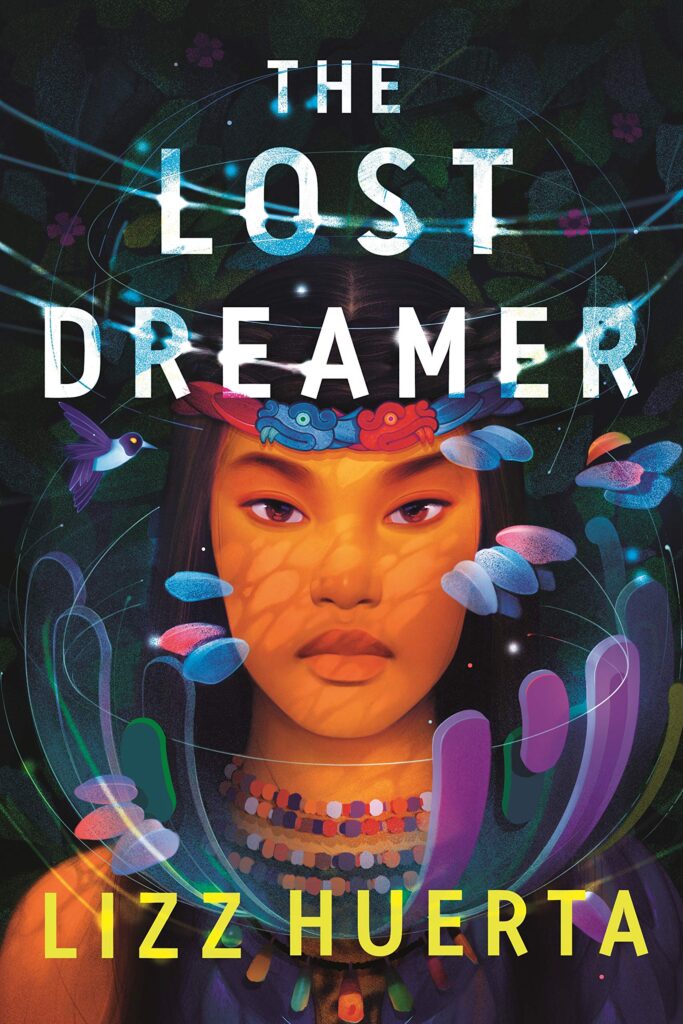
The Lost Dreamer by Lizz Huerta is another YA fantasy out on March 1st. I really like how I have been able to travel in time and space through YA while being firmly rooted to my tiny London flat during the past two years. The Lost Dreamer promises to transport us to ancient Mesoamerica and introduces the reader to a lineage of seers resisting the patriarchical state that would like to see them destroyed. And I’m all here for the destruction of the patriarchy! It tells the story of Indir, a Dreamer, descended from a long line of seers – she carries the rare ability to Dream truth. But she also holds secrets that will allow the new king to bring the Dreamers to a permanent end… Interwoven with hers is Saya’s story. She is a seer, but not a Dreamer, never been formally trained, and exploited by her mother as they travel from town to town. But as Saya loses the necklace she’s worn all her life, she discovers that she may have more gifts and that the life she knows may be a carefully constructed lie… This sounds really interesting and unusual! Order a copy via Book Depository here.
-
Star Father – Charlie N. Holmberg
Just a few months ago, I had the pleasure of reading and reviewing Star Mother, the first book in the Star Mother duology by Charlie N. Holmberg. Folks that read my review will remember that I was looking forward to the sequel, itching for the conclusion to a story that felt a touch incomplete without a satisfying ending for Saiyon’s character. I was surprised and pleased with how quickly Star Father was released, right on the heels of Star Mother, but unfortunately it was not the sequel I was hoping for. It’s difficult not to compare this book to its predecessor, as they really are meant to be read as a pair, and you’ll see that reflected in this review – it looks at how this book fares as both a continuation, and ultimately the conclusion, of the Star Mother duology. I received an ARC of this book from the publisher. All opinions are my own.
RELEASE DATE: 08/03/2022
STAR RATING: 3/5 ✶

SUMMARY:
In a heavenly war, the moon is prevailing…
It happens in an instant, filling Aija with dread: the Sun is suddenly cast from the sky, throwing the Earth into midday darkness. On the fourth day of endless night, Aija finds an unconscious man by the river. His skin is as hot as her lantern’s glass and just as golden. To Aija, a farmhand with the soul of an artist, this beautiful stranger is an inspiration—and a mystery. He calls himself Saiyon. He bleeds light. His friends are celestial. His enemies, godlings of the moon.
Between Aija and Saiyon, attraction grows warmer. For Aija, an unfathomable revelation: she’s falling in love with the earthbound Sun God. When Saiyon’s faltering powers are restored to full glory, what then? There’s a way Aija can become immortal, too. Saiyon can’t support such a risk.
Aija chooses to follow her heart to places darker and more dangerous than she realizes. Whatever sacrifices lie ahead, they’re the only way to make an impossible true love last forever.
OPINIONS:
The aspect of Star Mother that stood out to me was its theming. A personal journey of devotion, self-sacrifice, love, and motherhood formed the backbone of the first installment of this duology. The Romance was not an afterthought, but a carefully woven aspect of the story that served to amplify the themes while never presenting itself as the “main attraction.”
So, when I started Star Father, I was expecting something of the same. I knew that this book would be the conclusion to Saiyon’s story, giving him the HEA he needed for the story in Star Mother to feel complete, but I assumed it would be presented against the backdrop of the same type of deep and meaningful theming that grabbed me in that book. Unfortunately, that was not the case. The Romance is the main focus of Star Father; Aija and Saiyon falling in love followed by Aija’s quest to become immortal so that she can be with Saiyon is the focus of the plot and the characters’ motivations.
Those of you that know me are probably reading this and raising a brow: Does Romance-loving Kat actually think that is a bad thing? Has hell frozen over? Rest assured friends, I’m fine. Allow me to explain…
If you are going to make a book Romance-forward, i.e. the Romance is the plot of the book and there are no other plot elements through which to develop themes, you have to develop your characters deeply and meaningfully such that your themes are tied to the characters’ arcs and the romantic relationship must be transformative. That did not happen here. There was no growth in either Aija or Saiyon – their characters, dare I say it, were quite shallow and their relationship fell largely flat. I had a frisson of hope that Aija’s character would gain depth and grow through her art, especially given the plot point that involved creating a likeness of Moon, but alas that thread turned out to be perfunctory. And Saiyon, who’s struggle as a God beholden to the universe’s laws and for whom this book was ostensibly written, received very little page time and even less exploration into his history, motivations, or desires.
In short, I struggled to find any substantial themes in Star Father beyond Aija and Saiyon falling in love and finding a way to be together. Had the romance been rooted in something deeper, e.g. a personal realization or the resolution of some internal struggle, perhaps this book would have worked for me, but much to my chagrin, it didn’t.
I have the same small quibbles with this book as I did with the previous, finding the writing a touch overwroght at times, using metaphors that weren’t grounded in the story or the characters. Once again, the ending was a bit rushed given the amount of time Aija spent questing for immortality; much like the characters themselves, their HEA needed more attention and depth.
I’m glad I read this book, as I needed the conclusion to Saiyon’s story to feel complete, but I will admit that it wasn’t as satisfying as I had hoped. I will continue to recommend Star Mother, but with the caveat that I wouldn’t recommend Star Father and that it may leave you wanting.
-
Subjective Kind of Chaos Awards 2021
It’s that time again! Both Fab and I (Sun) are back as part of the judging team for the Subjective Kind of Chaos Awards for 2022. These are blogger awards, focused on speculative fiction across multiple categories and the awards have a shiny new website which can be found here. This year there are 14 of us, so plenty of scope for interesting choices and various chaos. The team consists of Adri (@adrijjy/Nerds of a Feather), Arina (@voyagerarina/Queen’s Book Asylum), C. (@themiddleshelf1), Imyril (@Imyril/There Is Always Room For One More), Kris (@hammard_1987/Cloaked Creators), L.A. (Aquavenatus), Lisa (@deargeekplace/Dear Geek Place), Matt (@runalongwomble/Runalongtheshelves), Leigh (@leighowyn), Robin (@spicymisorobin/The Book Wormhole) and Sia (Every Book a Doorway). But you’re not here to read about us – you’re here to see our fabulous nominees!
FANTASY
- Lucy Holland, Sistersong
- Khadija Abdalla Bajaber, The House of Rust
- Tasha Suri, The Jasmine Throne
- C.L. Clark, The Unbroken
- Zoraida Córdova, The Inheritance of Orquídea Divina
- Shelley Parker-Chan, She Who Became the Sun
- A.C. Wise, Wendy, Darling
- Laure Eve, Blackheart Knights
- P. Djèlí Clark, A Master of Djinn
SCIENCE FICTION
- Tade Thompson, Far from the Light of Heaven
- Calvin Kalsuke, Several People are Typing
- Nicole Kornher-Stace, Firebreak
- Claire North, Notes from the Burning Age
- Catriona Silvey, Meet Me in Another Life
- Adrian Tchaikovsky, Shards of Earth
- Brent A. Harris, Alyx: An AI’s Guide to Love and Murder
- Benjamin Rosenbaum, The Unravelling
- Arkady Martine, A Desolation Called Peace
BLURRED BOUNDARIES
- Ryka Aoki, Light from Uncommon Stars
- K. Eason, Nightwatch on the Hinterlands
- Un-Su Kim, The Cabinet
- Monica Byrne, The Actual Star
- T.L. Huchu, The Library of the Dead
- E. Lily Yu, On Fragile Waves
- Rena Rossner, The Light of the Midnight Stars
- Rivers Solomon, Sorrowlands
- Marshall Ryan Maresca, The Velocity of Revolution
DEBUT
- Lorraine Wilson, This is Our Undoing
- Ava Reid, The Wolf and the Woodsman
- Elly Bangs, Unity
- Louise Carey, Inscape
- Xiran Jay Zhao, Iron Widow
- Genevieve Gornichec, The Witch’s Heart
- E.J. Beaton, The Councillor
YOUNG ADULT
- Anna-Marie McLemore, The Mirror Season
- Namina Forna, The Gilded Ones
- Lilliam Rivera, We Light Up the Sky
- Krystal Sutherland, House of Hollow
SHORT STORY
- Ellen Kushner, Immortal Coil
- Malka Older, The Badger’s Digestion, or The First First-Hand Description of Deneskan Beastcraft by an Aouwan Researcher
- A.C. Wise, The Amazing Exploding Women of the 20th Century
- Isabel J. Kim, Homecoming Is Just Another Word For The Sublimation Of The Self
NOVELLA
- Shingai Njeri Kagunda, & This Is How We Stay Alive
- Yaroslav Barsukov, Tower of Mud and Straw
- Aliette de Bodard, Fireheart Tiger
- Chris Willrich, A Manslaughter of Crows
- Becky Chambers, A Psalm for the Well-Built
- Premee Mohamed, These Lifeless Things
- Adrian Tchaikovsky, One Day All This Will Be Yours
- Alix E. Harrow, A Spindle Splintered
- Catherynne M. Valente, The Past is Red
- Premee Mohamed, The Annual Migration of Clouds
- Dilman Dila, The Future God of Love
- Aimee Ogden, Sun-Daughters, Sea-Daughters
GRAPHIC NOVEL
- Molly Knox-Ostertag, The Girl from the Sea
- Hiromi Goto & Ann Xu, Shadow Life
- Rachel Smythe, Lore Olympus
- Wendy Xu, Tidesong
SERIES
- Natasha Ngan, Girls of Paper and Fire
- C.L. Polk, The Kingston Cycle
- T. Frohock, Los Nefilim
- Malorie Blackman, Noughts and Crosses
- James SA Corey, The Expanse
So as you can see, we’ve got quite a bit of reading to do in the next few months – between the two of us, we’re covering all the categories! But we’re excited to dive in, and looking forward to get back to you all with our thoughts on the nominees, and the finalists in due course.
-
Blog Tour: Stars and Bones – Gareth L. Powell
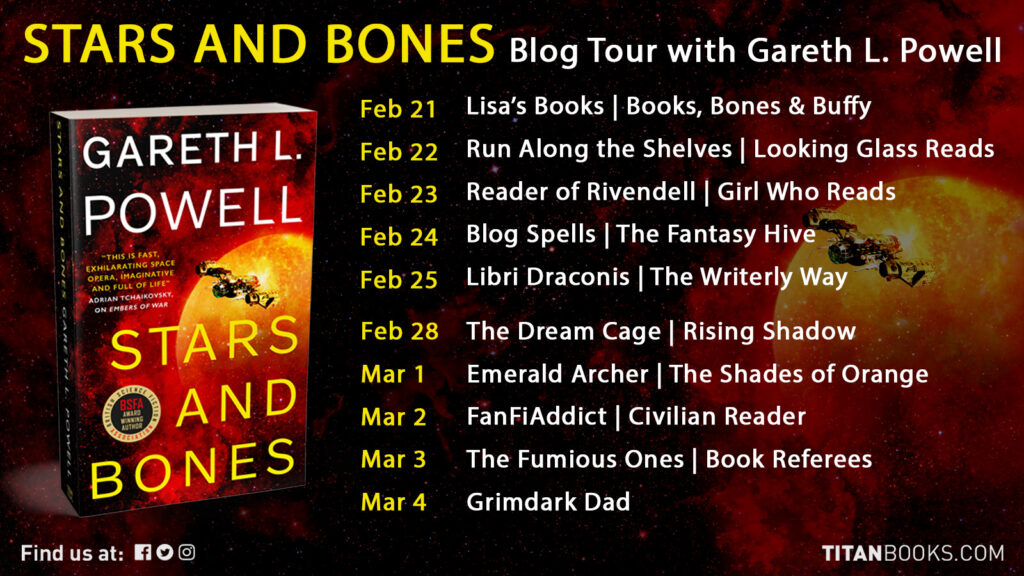
It is my pleasure today to welcome you to my stop on the Titan Books blog tour for Gareth L. Powell’s new space opera, Stars and Bones. Keep reading for a mini-review and a Q&A with the author! Many thanks to Lydia Gittins for sending me an ARC and inviting me to be part of the tour – all opinions are entirely my own.
2022 is the year Fab discovers how much she actually likes science fiction. Because there are just so many brilliant books in the genre releasing at the moment, and I’m lucky enough that I keep getting to review them. This was my first foray into Gareth L. Powell’s work, and I’m sure that it wont be my last. Stars and Bones is a highly character-driven story set in a future where humanity has been driven into space from a dying earth, to live on a fleet so-called arks. In this new society, Eryn is on a mission to save her sister – and perhaps all of humanity. It is a compelling story with strong characters – and a wonderful ship’s cat (yes, books with cats will make me fall in love with them instantly!). Honestly, if you like weird and quirky characters that can carry a story on their shoulders and make a plot that isn’t necessarily the most out there shine, this is definitely one that I whole-heartedly recommend. It is the sort of science fiction that to me is insanely comforting, and I’m already looking forward to rereading! (P.S. a story that has a British PM cause nuclear destruction through sheer incompetence is a winner in my book because I can’t resist black humour)
Add Stars and Bones to your Goodreads here, and order a copy via Bookshop here (affiliate link) – and read on below the image to hear Gareth talk about it (and get an impression of his wit, which permeates the book as well)!
RELEASE DATE: 01/03/2022
STAR RATING: 4/5 ✶
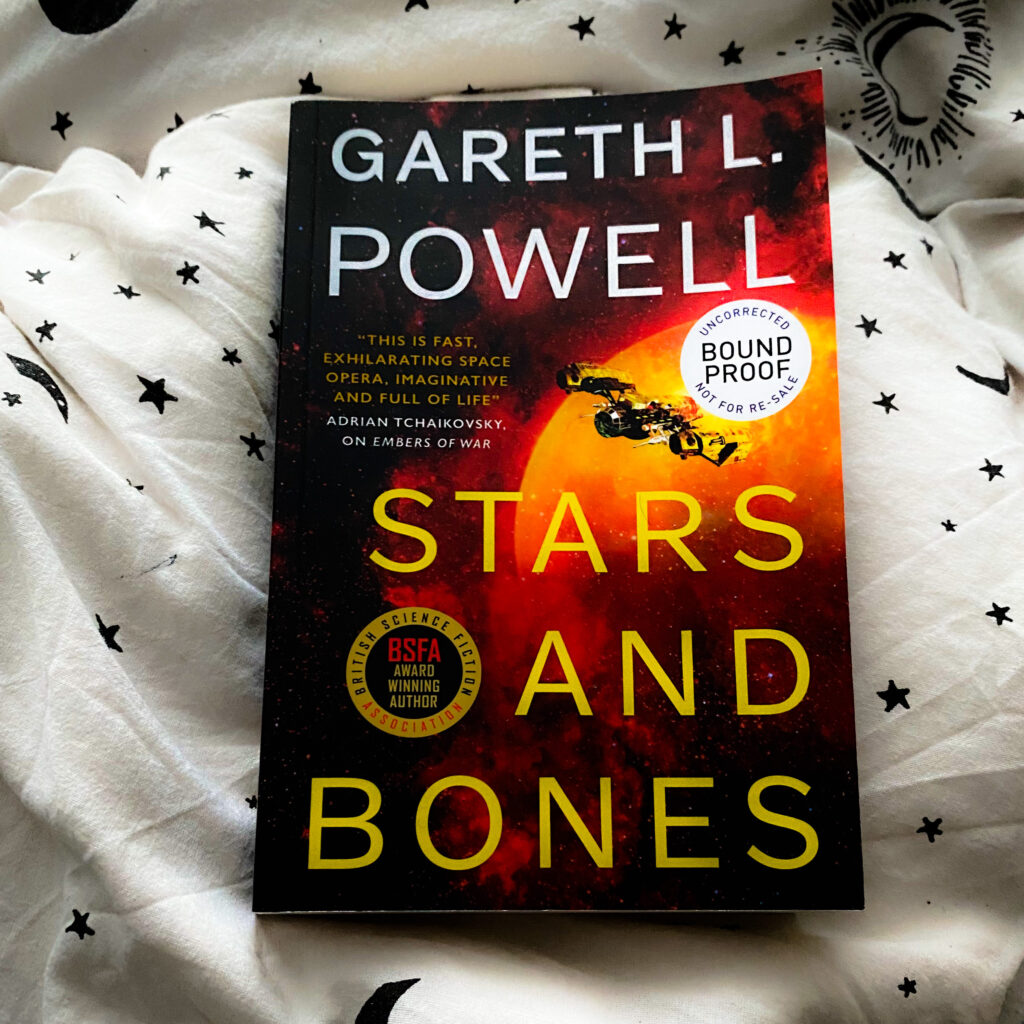
Can you pitch Stars and Bones in one sentence for our readers?
If you imagine Philip K. Dick got high and dreamt a crossover between Battlestar Galactica and The Thing, you’d be in the right ballpark.
One of my favourite parts of Stars and Bones were the characters and their relationships. Can you tell us a bit more about your process for them? And what comes first, the characters or the story?
I usually start with an idea for a situation, and then start searching around for the best characters to bring that situation to life. And then, once the characters start coming to life, their decisions and reactions drive the plot and final outcome of the story.
And what inspired the magnificence that is Sam?
I have a cat who spends a lot of time on my desk as I write, so I imagined what he’d say if he was in the story.
What role does humour play for you in science fiction?
For me, humour is part of everyday life. Funny stuff happens, and often at the most inappropriate of moments. So, if I’m trying to portray humans authentically, there has to be some humour in the mix—even if it’s only a way to lighten the tension in a horrific scene. I don’t write jokes or funny scenarios; the comedy arises naturally from the way the characters interact.
Is there anything you had to cut from the drafts that you’re sad about not having in the final version?
No.
How was this writing and publishing experience different as a new project after a completed trilogy?
Writing a new story after spending three years on a trilogy is always a huge mental gear shift. You get used to working with the same characters, and suddenly you have to adapt to a whole new set, and a whole new universe. But that’s good. I can’t imagine writing more than three books set in the same world, as I’d worry I’d get stale. You have to shake things up now and again.
How are you celebrating the release?
Well, it’s March 1st so I’ll also be celebrating the patron saint of my forefathers, and attending an online speeding workshop, as I got caught travelling 26 mph in what I thought was a 30 mph zone, but which turned out to have a 20 mph limit.
Do you have a set writing routine?
I used to have a set routine, but the last few years have introduced so much chaos and upheaval into the mix that, like sleeping, I now write whenever the opportunity arises.
What books or other media have filled your creative well recently
I’ve been reading The Organised Writer by my friend Antony Johnston and hoping some of it will rub off on me, as I am a very disorganised writer.
-
A Single Shard – Linda Sue Park
Award-winning middle grade published in a stunning 20th anniversary edition? That quickly peaked my interest – and seeing that the story of A Single Shard by Linda Sue Park was set in medieval Korea got me hooked. I didn’t think much further and screamed an enthusiastic YES when I was offered a review copy – massive thanks to Rock the Boat! And then the story drew me in and left me crying…
RELEASE DATE: 20/01/2022
STAR RATING: 5/5 ✶

SUMMARY: 13-year-old Tree-ear lives in a Korean village famous for its ceramics. He doesn’t have much but he loves to watch master potter Min at work and dreams of learning the craft one day.
Reluctantly Min agrees to let Tree-ear help him. Determined to do whatever it takes to prove himself, Tree-ear embarks on a dangerous journey to present his master’s work to the king, unaware it will change his life forever. (from Rock the Boat)
OPINIONS: A book that has me weeping by the end of it definitely deserves all five stars. It took me a little while to really get settled with the story, as you can tell that it’s a slightly older book – not in a bad way, but children’s books have changed a lot in how they approach storytelling and narrative in the meantime, so the set-up and pacing was a bit slower than expected, especially as the book was relatively short. It is the sort of story that drives the reader’s investment through character and emotions, rather than a full plot and constant action. In that respect, it is a children’s book that is of the sort that easily reads up, and has as much to give to adults as it does to young readers. I think it would also make for a great book to read aloud to a child that isn’t quite ready to read this on their own yet.
I loved Min and especially Ajima so much – despite not having a lot of speaking time in the novel, the gruff potter and his wife really grew on me as the story went on. Tree-ear is a lovely character, both young and naive as well as independent and self-sufficient. Nevertheless, more than anything, he is a boy who wants approval and attention, deep down. Ultimately, his story, his quest to support Min, to show the world what he’s made of is a universal story, one that will resonate with many readers.
A Single Shard shows how a great story doesn’t need to be epic or made up of grand adventures. It can be quiet, it can be the tender representation of a thread of kinship growing between two strangers, or the rip-roaring grief over a friend taken unexpectedly. It is a wonderful book, a sad book, a book that breaks your heart and reassembles it new. I loved it, and I hope you will too.
Add A Single Shard to your Goodreads here, or order a copy via Bookshop here (affiliate link).
-
Monday Minis
In true Monday Minis fashion, this is me catching up on reviews long overdue… As always, many thanks to the publicists for providing me with eARCs via NetGalley, and all opinions are entirely my own.
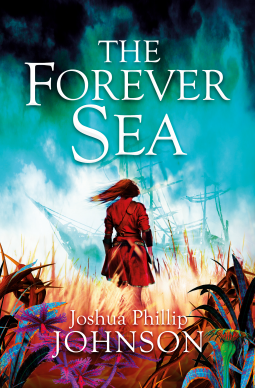
The Forever Sea by Joshua Phillip Johnson is a book that I struggled to connect with. Set in a world where there is an ocean made out of grass, on which ships propelled by magical hearthfires sail, this tells the story of Kindred, a young hearthfire keeper. Her grandmother, the Marchess, is a legendary hearthfire keeper herself and taught Kindred all she knows – and now she’s just found out that the Marchess supposedly killed herself by stepping into the sea. But Kindred is sure that there is more to the story, and that her grandmother is alive. And to find out more she is willing to risk everything and betray everyone – including her own crew. I loved the concept, but I found the characters unlikeable in a way that made me disconnect emotionally. I originally started reading this as an ebook as I was sent an eARC, and switched to audio after it had come out and I still hadn’t made much headway, but it still took me far too long to get through. I had to take long breaks in between reading this because while I did enjoy the story, it is the kind of writing that I soon feel like I’ve had enough of. It is a book that felt drawn out and slow to me, one that I just didn’t click with. The Forever Sea addresses a lot of very interesting ideas and topics – not least of all, the impact of finite resources on a society and climate change, but ultimately, while I can appreciate its good points, it wasn’t a book for me.
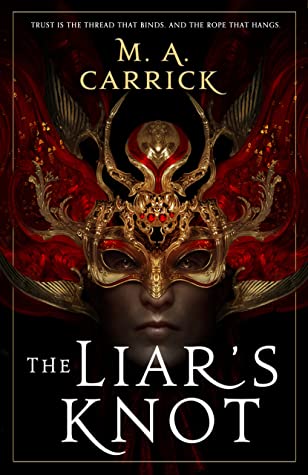
The Liar’s Knot by M.A. Carrick is the second book in the Rook & Rose series. Following up on The Mask of Mirrors, this continues Ren’s story as she infiltrates Naszrenian society and tangles with the masked vigilante known as the Rook. Despite loving Marie Brennan’s – one of the co-authors – Memoirs of Lady Trent, this story failed to captivate me in the same way. In theory, this should be exactly my cup of tea, as it has characters of dubious morality, great descriptions and a fair dose of betrayal and backstabbing, but in practice, I didn’t like the first book as much as I wanted to, and felt similarly about this second volume. Individually, I love Ren, Tess, Vargo and Grey, and think they are brilliant characters whom I would love to learn more about. But in combination, I’m just not invested. Perhaps it feels like there’s too much of a good thing, too many storylines that are individually interesting, because in some ways, it seems to me that the series is meandering along, unsure where it is heading. I don’t dislike it, and I will probably pick up the next book too because I can’t help myself, but for me these are solid three star reads.
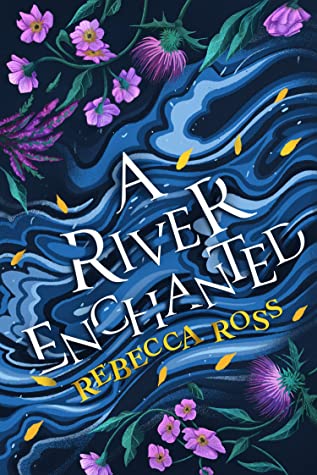
A River Enchanted by Rebecca Ross is a wonderfully enchanting tale set on a Scotland-inspired island, the isle of Cadence. Split in East and West, with bad relations between the areas, inhabitants live in a medieval-ish society, though one where magic is real. Jack returns to the island after years of studying music on the mainland, hoping that his skills as a bard will help the heiress Adaira track down a series of missing children. It is a fairly slow-paced story, but one that nevertheless weaves its song around you and enchants the reader. I loved the characters, the honesty between them, and the lack of inhibition to confront hard topics. That really made this stand out for me. The story does go in a lot of unexpected directions towards the last third, and now I’m really keen to get my hands on the next book in the series. If you like mythical, atmospheric tales this one may be a good choice to pick up.
-
Scorpica – G. R. Macallister
Scorpica, the first book in G.R. Macallister’s The Five Queendoms series is billed as a feminist Game of Thrones, which is somewhat misleading. Not every epic fantasy with Grimdark elements is like Martin’s work! But that’s one of my pet peeves. It’s more like Tasha Suri meets Joe Abercrombie if I had to give some comps, although this was one that felt like it didn’t quite manage to hit the expectations set out by its scope.
Many thanks to Sarah Mather at Titan Books for sending me an ARC for review, all opinions are my own as usual.
RELEASE DATE: 22/02/2022
STAR RATING: 3/5 ✶
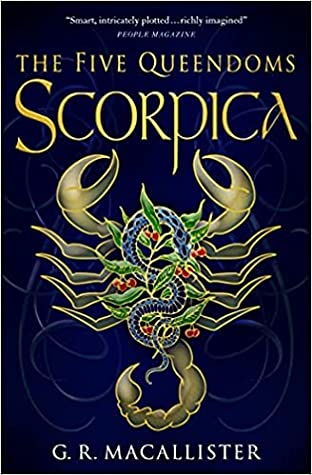
SUMMARY: In an ancient matriarchal world of magic, gods and warriors, the last girl – unbeknownst to the five queendoms – has just been born. As time marches on, the scribes of Bastian find no answers in their history books. The farmers of Sestia sacrifice their crops to the gods. Paxim, the empire of trade and dealings, has nothing to barter but boys and more boys. Arcan magic has no spells to remedy the Drought of Girls. And finally, Scorpica, where every woman is a fighter, their commander, their queen, has no more warriors to train. The lines of these once-great empires soon to die.
After centuries of peace, the ensuing struggle for dominance – and heirs – will bring the five queendoms to the eve of all-out war.
But the mysterious curse is linked to one of the last-born children, an orphaned all-magic girl, who is unaware she has a claim to the Arcan throne… (from Titan)
OPINIONS: This is one of those books where I’m not sure what to think about it. I think the copy comparing it to Game of Thrones is very ill-fitting, as it feels more like a love child of Joe Abercrombie and Tasha Suri – political fantasy focusing on a grand scope, in a South Asian/Arab inspired world, with some Grimdark elements, but nowhere near the George R.R. Martin-like scope of close PoVs that switch quickly. The narration is really much further removed – which may be part of what made me struggle with the story as I tend to focus on the emotional connection I have with what is going on more than anything else. I have noticed that I tend to be far more forgiving of a story that connects with me, while one that doesn’t makes me be critical of every last detail as it doesn’t absorb me while reading – and one of the things that I’ve found makes a difference in how well I connect is how far removed the narration is from the characters. So wide shots of scenes make me care far less than lots of close-ups that let the reader piece together the grand picture over time.
That said, I am intrigued enough that I will be picking up the next volume in the series when it is ready – I feel like this, while it is rather large, is just enough to whet the reader’s appetites. It doesn’t feel like a story that stands on its own – not a satisfying one at least – very much like part of an ongoing series, so for me, how it goes on will make or break it as a whole. Scorpica is fun to read, and of an epic scope – and I am curious to see how the questions posed in this first book will pan out.
I do wish that Scorpica focused a bit more on individual characters rather than sweeping political happenings, as I did feel that I didn’t get to know the characters as well as I would have liked to. This is a series that will appeal to those readers who enjoy the epic scale over the personal stakes at work, and an almost cinematic approach to storytelling. It is the sort of story that is predestined for adaptation, with a rich world, visual contrasts and the style of writing. So even if it didn’t fully convince me, it is definitely the start of a series to watch out for, and one that will likely make many readers fall in love with it.
If you are intrigued, you can add Scorpica to your Goodreads here, and pre-order a copy via Bookshop here (affiliate link).
-
The Atlas Six – Olivie Blake
Damn this book. In an elevator pitch, I’d describe it as sexy and compelling – it’s that kind of book. Once you get sucked into it, you just can’t stop. I’m so glad I’ve got my reading mojo back thanks to these lovely publicists sending me the exact right books to get me out of my slump – The Atlas Six and Blood Scion worked wonders! This is one of the most hyped releases of this spring, and I hate to say it, but the hype is correct…
Massive thanks to Black Crow PR and UK Tor for spoiling me and sending me an ARC. All opinions are entirely my own.
RELEASE DATE: 03/03/2022
STAR RATING: 4.5/5 ✶
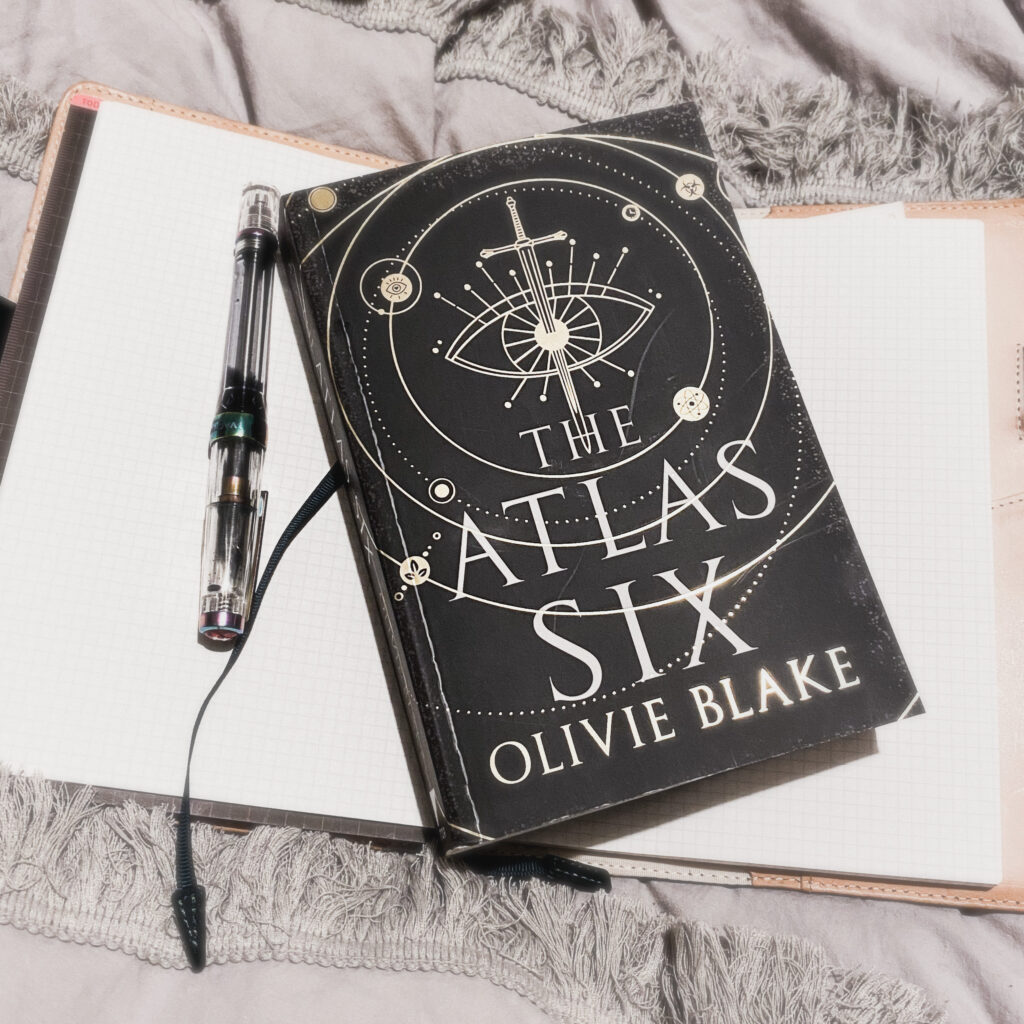
SUMMARY: The Alexandrian Society, caretakers of lost knowledge from the greatest civilizations of antiquity, are the foremost secret society of magical academicians in the world. Those who earn a place among the Alexandrians will secure a life of wealth, power, and prestige beyond their wildest dreams, and each decade, only the six most uniquely talented magicians are selected to be considered for initiation.
Enter the latest round of six: Libby Rhodes and Nico de Varona, unwilling halves of an unfathomable whole, who exert uncanny control over every element of physicality. Reina Mori, a naturalist, who can intuit the language of life itself. Parisa Kamali, a telepath who can traverse the depths of the subconscious, navigating worlds inside the human mind. Callum Nova, an empath easily mistaken for a manipulative illusionist, who can influence the intimate workings of a person’s inner self. Finally, there is Tristan Caine, who can see through illusions to a new structure of reality—an ability so rare that neither he nor his peers can fully grasp its implications.
When the candidates are recruited by the mysterious Atlas Blakely, they are told they will have one year to qualify for initiation, during which time they will be permitted preliminary access to the Society’s archives and judged based on their contributions to various subjects of impossibility: time and space, luck and thought, life and death. Five, they are told, will be initiated. One will be eliminated. The six potential initiates will fight to survive the next year of their lives, and if they can prove themselves to be the best among their rivals, most of them will.
Most of them. (from Tor)
OPINIONS: There are many different things I tend to like about books. But selfish people in an academic setting, competing, sleeping with each other and other people and a healthy dose of backstabbing and magic is a formula that never fails to grip me. And The Atlas Six can compete with the best of them in that regard. It is the sort of book you just have to devour once you get stuck in, the kind that makes you stay up far later than you’d like because you simply need to know how it ends. And now I am eagerly waiting for book two…
It is not highbrow or necessarily the most creative story out there. It is made up of a slew of tropes, but I think that’s exactly where this book’s charm lies. It takes many of the elements from books we’ve all read and loved growing up and turns them into pure entertainment. In some ways, The Atlas Six is a The CW show of fantasy books – glossy, full of beautiful people who really are horrible, and compulsively readable, pure escapism. And for me personally, that’s exactly what made it resonate so much. Taking these shiny elements that made it fun, adding a good pinch of escapism and combining that with the magic school and library setting that I click with as a book nerd? You’ve got a winning formula there.
And despite the characters all being objectively terrible and selfish people with moral issues, I loved basically all of them. For me, that speaks to good writing – because them being interesting mattered more than them being actually likeable, and they charmed their way into my heart anyways. I think my favourite was probably Libby, disaster bisexual that she is, with her weird rivalry with Nico, bordering on obsession. But honestly, all I want to do is start rereading the book again. I have a feeling this may become a comfort read…
Add The Atlas Six to your Goodreads here, and pre-order a copy via Bookshop here (affiliate link), though it’s worth checking if Waterstones, Illumicrate or Fairyloot still have any of their announced special editions available…
-
The Novellas of Osten Ard
Over the past year, I had the pleasure of returning to Osten Ard with two novellas that book-end the original Memory, Sorrow, and Thorn series: The Heart of What Was Lost and Brothers of the Wind. Once again I am astounded by the greatness that is Tad Williams. I know, I know, I’m a total fangirl, but I can’t help but argue it’s with good reason! For fans of Tad Williams, getting the opportunity to return to the rich and sprawling world that is Osten Ard with a targetted, short-format purpose that nonetheless delivers his style of prose, world-building, and characterization (twice!) is beyond satisfying to say the least. For me, it’s like wrapping myself in a warm blanket and drinking a cup of tea – pure comfort through the written word. Although these novellas vary significantly in terms of their themes and objectives, they are both quintessentially Tad Williams and fit perfectly into and expand upon the experience of Osten Ard. All opinions are my own.
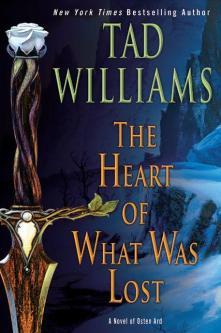
Publication Date: January 3, 2017
Rating: 5/5 ✶
Summary: The Heart of What Was Lost takes place in the half-year after the end of To Green Angel Tower, and tells of the attempt by Isgrimnur and a force largely made up of Rimmersgard soldiers to destroy the remaining Norns as they flee back to their homeland and their mountain. It also answers some questions about what actually happened in the immediate aftermath of the fall of Green Angel Tower.
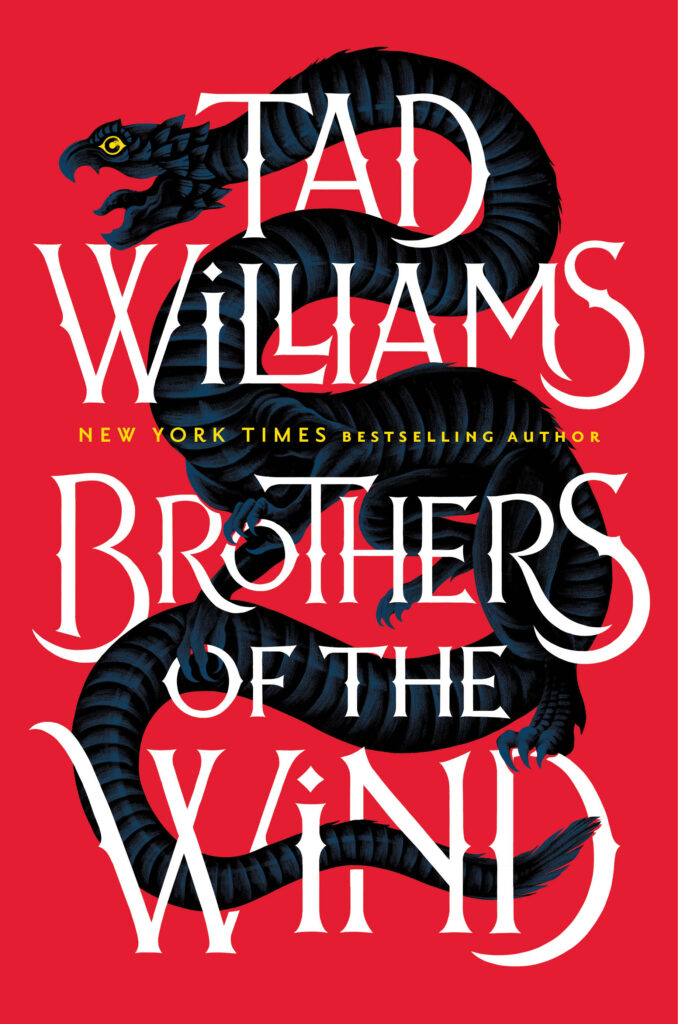
Publication Date: November 2, 2021
Rating: 4/5 ✶
Summary: Set a thousand years before the events of Williams’s The Dragonbone Chair, Brothers of the Wind tells the tale of Ineluki’s tragic boast to destroy the deadly dragon Hidohebhi and what it brings from the POV of Pamon Kes, Hakatri’s faithful servant. Kes is not one of the Sithi but a member of the enslaved Changeling race, and his loyalty has never before been tested. Now he must face the terrible black dragon at his master’s side, then see his own life changed forever in a mere instant by Ineluki’s rash, selfish promise.
The plot of The Heart of What Was Lost focuses on Duke Isgrimmnur’s pursual of the retreating Norns and epic siege of their home Nikkiga (siege fans – this book is for you!) after the human and Sithi victory at Asu’a. The plot forms the basis for not only delivering page-turning action and world-building, but also two main themes: the tendency the de-humanize an enemy in war, in this case the Norns, and a reminder that the atrocities and brutalities of war exist on a personal level and represent its true cost.
Williams’s use of multiple POVs is strategic and perfectly executed to support the book’s themes. First, he presents part of the story through the contrasting viewpoints of Duke Isgrimmnur, who leads the charge on Nikiiga, and Viyeki, a noble-born Norn working to protect his race from being exterminated at the hand of the human invaders. After witnessing the atrocities of the Norns throughout Memory, Sorrow, and Thorn, this fascinating juxtaposition in POVs requires an empathy from the reader that is unexpected and yet very real. The Norns are a noble people in their own right, simply fighting for their existence. Experiencing their way of life within their home “humanized” the Norns and further deepened the world-building of Osten Ard in a way that changes your view on the war.
Williams pulls on your hearstrings in an entirely different manner with a third POV, that of Porto, a mercenary conscribed to help finish the war in the North. The care-abouts of an average soldier and his young comrade-in-arms, e.g. wanting to return home to family, questioning why they are there, hunger and cold, provide a stark contrast to the “noble endeavor” of eliminating the last vestiges of their land’s mortal enemies. Here the reader is reminded of the brutal realities of war, and for me, the reminder was poignant.
Finally, and as always, Williams is adept at weaving the stories of these myriad characters in such a way that the ending is both powerfully unexpected and thoroughly satisfying; all loose ends are tied.
Brothers of the Wind tackles entirely different themes using the single POV of Pamon Kes, Prince Hakatri of the Sithi’s armiger servant of the enslaved Changeling race. The book is split into two main quests, the first of which is to slay the dragon Hidohebhi, and the second to find a cure for the pain and madness plaguing Hakatri who has been burned by Hidohebhi’s magical blood. Aside: It was a delight to visit all my favorite locations in Osten Ard during Hakatri’s quest for a cure – the Wran, Sesuad’ra, Aldheorte, to name a few. It was like a mini-recap of Simon’s journey through Memory, Sorrow, and Thorn, and I thoroughly enjoyed it!
Again, in true Williams fashion, the plot serves the themes, which are twofold and strikingly disparate. First, he explores the slippery slope that is unchecked hubris and anger. Readers are finally presented with the backstory of Prince Ineluki’s seduction by the Norn queen. She manipulates Ineluki’s anger with himself and his love for his brother into hatred for the humans, thereby providing him an outlet for his tumultuous emotions and ultimately gaining his allegiance. At the same time, Williams tells this entire story through the POV of Hakatri’s devoted servant. The reader is not only given a deeper understanding of the Changeling race, but also the sacrifces Pamon has made with respect to his identity – both through his own choice and unintentionally through racism and social constructs – because of his blind devotion to his master Hakatri. The noble Sithi are not without fault, and once again the world-building of Osten Ard is deepened through the exploration of this unsettling relationship between the Sithi, Norn, and Changeling races.
There is a heart-warming end for Pamon Kes; he is released of his servitude to live his own life and learn the history of his people. But, surprisingly, the reader does not learn the ultimate fate of Hakatri. Does he ever find his relief across the sea? Who was the mysterious woman in his visions, and what was the choice she foretold he might make? How will this affect Osten Ard? Williams has left the door open for these questions to be answered in the final two installments of The Last King of Osten Ard, but the conclusion of the story did not suffer because of it.
It was a pleasure to return to the world of Osten Ard and several of its characters in these two novellas. The stage is set for the follow-on series, The Last King of Osten Ard. Although you don’t have to read Memory, Sorrow, and Thorn to enjoy either of these short books and get a feel for Williams’s manner of writing, the context is key to experiencing the full impact of their objectives. Highest of recommendations!
A bookish nerd sharing reviews of current SFF novels