-
Fire of the Frost – Darynda Jones, Jeffe Kennedy, Grace Draven, Amanda Bouchet
Fire of the Frost is a Fantasy Romance anthology consisting of four distinct novellas, which is quite an ambitious undertaking. Writing Romance novellas is hard, and compiling four well-executed Romance novellas even harder. Why? Because Romance novellas often suffer from the problem that there isn’t the page time to develop the characters in enough detail to make the plot or the romance believable. Layer on top of that a genre like Fantasy, and you’re faced with an even trickier prospect – now you also need page time to flesh out the world-builidng to the degree needed in support of the story or the romance.
However! It can be done! In the right hands, an author can construct a novella-length story that delivers on the promises of the premise of both Fantasy and Romance. In my opinion, Fire of the Frost accomplishes that, and I’ll try and unpack why it is so successful here by looking at each of the four novellas separately.
This review was originally written as part of a personal project to complete an all Fantasy Romance card for r/fantasy’s 2022 Book Bingo. You can read an introduction to my project here. All opinions are my own.
RELEASE DATE: 05/01/2022
STAR RATING: 4/5 ✶

A Wynter Fyre by Darynda Jones – 5/5
This is the shortest novella in the anthology, and despite the story being standalone, it really worked for me, I think, for three reasons. First, much of the page-time is dedicated to the world-building, and since the world itself is what drove the plot, the author made a good choice here. This is great literary device for managing page time – tie your world into the driving plot points and suddenly you’ve created a page efficiency that you wouldn’t otherwise have.
Second, the steaminess is not tied to the HEA. I know – you’re thinking gratuitous sex? Well, maybe a bit gratuitous, but I don’t think so. If you don’t have time to have your characters fall in love, add steam another way, avoiding insta-love altogether. That’s what the author did here. I’d be remiss if I didn’t add a content warning – there is dubious consent in the opening scene where the FMC is assaulted by vampires after being bitten and injected with what is essentially aphrodesiac vampire venom. This didn’t bother me and, like I said, I thought it was an ingenious way of getting the FMC and MMC into a steamy situation (he did not perpetrate the assault – their encounter came after), but I know that this is a big trigger for some folks, so reader beware!
Finally, and perhaps most importantly, this book had an HFN as opposed to an HEA, making the relationship arc far more believable. Our couple doesn’t go all the way to love and a full HEA, but you get the sense that their HFN will lead to a true HEA and that is enough to make you feel complete while avoiding the feelings of the end being contrived and reeking of insta-love. The plot twist and relationship reveal is key to achieving this story. It was unexpected and made the plot work.
Of Fate and Fire by Amanda Bouchet – 4/5
Another way to make a Romance novella work? Write the story of a secondary character from an ongoing series. The world has alrady been established, the backstory of at least one of the characters is already in the mind of the reader, and you’re able to use your page time to develop the plot and Romance. That’s exactly what Bouchet does in Of Fate and Fire, which is a novella set in her Kingmaker Chronicles world. It contains the story of what happens to Piers after he is banished from Thalyria by Athena.
For me, that was always a tough scene – I was SO conflicted about Piers’s fate, and for him to get a bit of character redemption and an HEA was extremely satisfying. The story is set in NYC at Christmastime, and the “big bad” is this billionaire tech mogul, both of which were extremely satisfying plot points (especially the downfall of the billionaire). I also love how much Bouchet leans in to her Greek heritage and mythology. She really leveled up with those elements in this novella, having the FMC being a part of a Greek immigrant family and a descendant of Heracles. I’m really looking forward to book 4 in the Kingmaker Chronicles series, which comes out this fall!
The King of Hel by Grace Draven – 4/5
If you follow my posts and reviews, you know that I’m a huge Grace Draven fan. She consistently delivers, and this story is no different; it has the tone, prose, and world-building I’ve grown to love in her works. This was the first story she ever published, expanded into novella for this anthology. It is standalone, and effortlessly tackles world-building and character development within the confines of a novella’s short length. Draven is truly a master of Fantasy Romance.
The novella is as much a love story between Castil and her best friend as it is between Castil and Doranis. The tone is rather somber, tackling themes of inequity and loss. Each of the three main characters is bound by the expectations of their birth, relegated to class expectations and rights. Yet amid the unfortunate outcomes of being forced to live within those societal strictures, love and friendship perservere. A poignant tale that fans of Grace Draven will thoroughly appreciate.
Familiar Winter Magic by Jeffe Kennedy – 3/5
This novella was my least favorite of the anthology, but that had more to do with my personal taste in tropes than anything else. In general, I am not a big fan of magic schools or YA-leaning characters, and since this story followed the relationship of two students of the Convocation Academy – the magic school in Kennedy’s Bonds of Magic world – it wasn’t my preference. However, I know this isn’t a turn off for others, so if you like that series and Kennedy’s writing (which is fantastic!) and want to delve deeper into the unique world-building that is an allegory for slavery and caste systems, this might be a great novella for you!
Familiar Winter Magic is another example of a novella set in an existing world, but unlike other examples I’ve read that employ this approach, this novella is far more tied into the main storyline of the series than usual. Although the characters and relationship are well-developed, it reads almost like a prelude to book 3, with multiple references to the series plotline and a cliffhanger ending that ostensibly will be resolved in book 3. I recommend this novella primarly to fans of the Bonds of Magic series as its an excellent and compelling entry into that world.
-
The Demon’s Daughter – Emma Holly
I get my recs for Fantasy Romance from a lot of places, and this particular book was rec’ed to me on r/RomanceBooks over a year ago as part of a request for well-written, adult Fantasy Romance books (not YA, not NA, no romantic subplots, etc.). It’s been sitting on my TBR since that time until I recently started the process of culling my TBR and searching for books that might fit my all Fantasy Romance r/fantasy Book Bingo card. I didn’t know anything about Emma Holly going into this book aside what I’d learned from some online book buddies – she is best known for Erotic Romance (Romance that is steamier than most, packing more explicit sex than your average Romance) as well as late 1990’s early 2000’s SFF Romances. So, I decided to give it a try.
I continue to marvel at the luck I have falling into books that seem to be made for me. This book screams Kat; it checks so many boxes for me, it’s almost scary. Look – I’m not going to say that what I like is close to being universal. This review is going to be more of a list of why this book works for me, and if you read it and you find that what works for me also works for you? Well, then I highly recommend reading The Demon’s Daughter by Emma Holly, because it was absolutely satisfying.
This review was originally written as part of a personal project to complete an all Fantasy Romance card for r/fantasy’s 2022 Book Bingo. You can read an introduction to my project here. All opinions are my own.
RELEASE DATE: 02/11/2004
STAR RATING: 5/5 ✶

I really enjoy the approach to world-building that fuses a quasi-historical settings with a completely different world. I’ve read this a couple of times, and this book solidified my love of this approach. The author took late Victorian era London and pieces of its history and plunked it down inside a secondary world and alternate history on another planet with a race of demons. She then deepens the immersion through the use of chapter epigraphs that are meant to be excerpts from various historical texts. The world-building was this amazingly creative fusion of ideas and histories, and I was totally diggin’ it.
The theming in this book draws on this world-building, focusing on both the human-demon interactions as well as the class structure within both races. Much of the conflict stems from racism between humans and demons, with both Adrian and Roxanne struggling given their unique ties to the demon race. Layer on top of that the classism that exists in both worlds, and you have a solid foundation for a plot rife with societal tension.
I loved Adrian and Roxanne, the main characters in this book; I felt very connected to them and wanted them to find happiness both for themselves and with each other. Like most modern Romance books, this book is dual-POV, and the development of each character is rich and engaging. I will admit that my preferences tend to older protagonists given my age and the point I am in in my life, and so it was a pleasant surprise to find that the MMC is in his early 40’s and the FMC around 30.
Adrian is not Alpha in any way, but an emotionally-connected man deseparate to find love after a failed marriage and a lonely life dedicated to his job as a Inspector (this book gives off a strong detective noir vibe). He wants the type of family he grew up with, and we get to see a glimpse of what that looks like when he visits his parents. His parents wanted a better life for him than they had, and his drive, the choices he makes with his first marriage, and his decision to take the demon implants all stem from these familial drives. The themes of race and class dynamics and family all tied together nicely to form Adrian’s character arc.
But the same is true for Roxanne. She is alone in this world, never knowing her father and losing her mother at a young age, but she creates a family for herself adopting two children and shapes a life around her art that is uniquely her own. This book has a tremendous message of women’s independence – Roxanne is a force to be reckoned with in an era where a woman’s worth was associated with her husband and her family. She stands apart, making her own living with her art and conducting her day-to-day life in the manner that suits her regardless of societal expectations.
By the end of the book, I realized that The Demon’s Daughter is very much a book about family. It’s a theme that is revisited and explored throughout the story, from Roxanne’s adopted children, to Adrian’s massive family, to the difficult relationship Roxanne has with both of her parents, and finally the formation of a family of their own.
The Demon’s Daughter is a deeply sensual book, and I didn’t realize how much I’d been craving that. Yes, this book does get steamy – Emma Holly is known for her Erotic Romance – but what stood out for me was the intense sensuality of the couple for much of the first half of the book in the form of simple touching, caresses, and foot massages, as an example. That being said, this book does pack a lot of steam, so if you like your explicit sex scenes on the thinner side, this might be a bit much for you.
Finally, the prose. I found this book extremely well-written. It didn’t feel basic, nor was it overwrought. Instead, is struck the perfect balance for me, reflecting the tone the author wanted to deliver with nary a hiccup.
I highly recommend this book. I adored it. I’m not sure if I will read the other two full-length entries in this series – I felt complete at the end of this book – but I am so pleasantly surprised and happy to have read The Demon’s Daughter.
-
Blog Tour: Sistersong (paperback) – Lucy Holland
In my current research project, I have this knack – I’m working on the Horned God in fantasy fiction, a figure that usually pops up on the sidelines or has a very limited presence, but casually browsing bookshelves in a shop or library, I’ll often pick up a random volume that catches my eye – and there he is. It’s uncanny, honestly! This was certainly the case with Sistersong. I picked the volume up on recommendation from Fabienne and because I enjoyed Lucy Holland’s previous fantasy oeuvre, the Worldmaker trilogy. I did not expect to find Cernunnos in its pages, nor did I expect that this novel would come to occupy such a central space in my research.
Sistersong weaves a sellic spell that pluck at the heartstrings and leaves the reader wondering.
RELEASE DATE: 28/04/2022
STAR RATING: 5/5✶
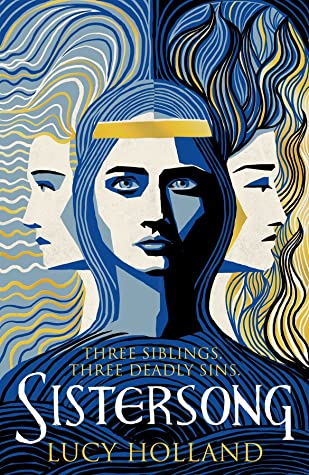
SUMMARY: King Cador’s children inherit a land abandoned by the Romans, torn by warring tribes. Riva can cure others, but can’t heal her own scars. Keyne battles to be seen as the king’s son, although born a daughter. And Sinne dreams of love, longing for adventure.
All three fear a life of confinement within the walls of the hold, their people’s last bastion of strength against the invading Saxons. However, change comes on the day ash falls from the sky – bringing Myrdhin, meddler and magician. The siblings discover the power that lies within them and the land. But fate also brings Tristan, a warrior whose secrets will tear them apart.
Riva, Keyne and Sinne become entangled in a web of treachery and heartbreak, and must fight to forge their own paths. It’s a story that will shape the destiny of Britain (from Pan Macmillan).
OPINIONS: First and foremost, this is an excellently researched novel. The historical details are grounded in both medieval chronicles and longstanding tradition of reimagining the Middle Ages, but Sistersong also respectfully engages with concerns of the 21st century, especially gender politics and notions of spiritual autonomy.
As for the Horned God, Cernunnos, his godhood is more literary than factual – the name survives to us in a single inscription of a Gallo-Roman devotional stele discovered in Paris (you can see it here), and archaeological evidence suggests he was a local deity subsumed into the Roman pantheon as Gaul became part of the Roman Empire. Further concrete information about how he was worshipped and by whom is lost to history, but he did find an ally in anthropologist Margaret Murray, whose ideas can be considered key for modern paganism in the West. Murray suggested that Cernunnos was one example among countless expressions of a pan-European Horned God, embodiment of male sexuality, wildness, and the natural world. This idea was taken up by fantasy authors to give Cernunnos a revived divinity. And he makes his appearance in Sistersong, along with Celtic goddesses Andraste, Brigid, and Epona.
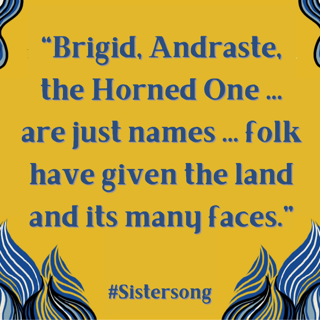
What struck me specifically was the gods were seen as ways of understanding the natural world. It’s something I’m arguing in my thesis: pagan gods in fiction are used to bring to mind nature and our relationship with it. And Holland presents this idea is a wonderfully eloquent way: at one point in the narrative one of the protagonists discusses the nature of magic with Myrdhin/Mori, a mysterious mentor character. Mori insists that there are no gods, and that ‘Brigid, Andraste, the Horned One […] are just names […] folk have given the land and its many faces.’
Throughout the novel, humanity’s union with and attention to the land is leitmotif that defines the characters’ success or downfall – forget the land’s name and you forget yourself. Without overtly referencing the current ecological catastrophe, Holland brings to mind the importance of human compassion to our environment. I found this incredibly powerful.
Now that Sistersong is out in paperback, do give it a read yourself and delve into legends of spectral hunts, ancient monuments and the uncanny bond between three siblings.
A bookish nerd sharing reviews of current SFF novels