-
The Binding – Bridget Collins

This must be one of the prettiest newly-published books I’ve ever seen. Not only is the cover gorgeous, but the spine is reminiscent of older, hand-bound books. And once you take off that wonderful dust cover, the naked glory of the book really shines… And it’s contents are just as beautiful.

STAR RATING: 5 ✶
PUBLICATION DATE: 10/01/2019 UK // 16/04/2019 US
SUMMARY: In a late early modern inspired world, young Emmett Farmer is sent to be apprenticed with a mysterious binder instead of taking over his father’s farm. He slowly learns about bookbinding, until he finds out what binders truly do. This leads to a series of events unravelling the darker sides of the craft, and ultimately to Emmett discovering his own past and finding love. (This one is really hard to summarize while trying to avoid spoilers!)
OPINIONS: I originally got pulled in by the beautiful cover, and the beautiful hardback ARCs I kept seeing on social media, and stayed for magic and bookbinding. But that is really not what this book is about. At it’s centre is love, love developing and love worth fighting for, but also love turned sour, abuse and issues of respect. And I should probably mention that the romantic relationship is between two men – which I find great!
The book is split into three parts, each uttely different, but equally captivating. In a way, they can be described as present, past and future – showing ‘present’ Emmett learning how to bind, flashing back to ‘past’ Emmett falling in love despite his best intentions not to like the man in question, and the third part opens the door for ‘future’ Emmett, who can recover his lost love and build a life according to his own desires. The writing is truly extraordinary, and somehow, fitting perfectly with the story and the physical book, both captivating and slow-burning. I tried to savour this book, trying to read individual chapters between tasks, until I got sucked in and read far past my bedtime.
Binding is a kind of magic, and binders are seen as witches by the general population – reminiscent of real-world history witch-hunt, a Crusade against them took part approximately 60 years before the events of this novel. Binders are born, not made, as I understand the story, and have black-out like symptoms to indicate their powers – these allow them to work willing subjects’ memories into bound books, allowing the subjects to forget. This can be a trade agreement, cathartic act, or even abuse. There is much debate about the morality of binding, and therefore the sale of books, and I found it very interesting to think about matters from this very different perspective.
The main characters, Emmett and Lucian, are extremely well developed and grow in their flaws and strengths over the course of the story. Their arcs drive the story, which is one of my favourite parts about novels, and I loved that this story allowed its magic to unfold slowly, without stuffing the story with unnecessary action. However, I do worry that this will put off many readers – but honestly, that’s their loss! The love story is incredibly well-developed and builds slowly and naturally, while also addressing class issues. This theme then becomes central to the third part of the book, where Lucian’s rich and powerful father consciously abuses his privileged position, abuses his servants (one of which his cycle of abuse and binding drives to suicide).
In short, please read this book, and be kind to the humans around you!
-
Anna Undreaming – Thomas Welsh
This is my first ever physical review copy! Many thanks to Tom Welsh and Owl Hollow Press for entrusting me with a copy of Anna Undreaming – and many apologies for taking so long to actually post the review.

Don’t worry, I’ll get to talking about the pretty in a second! But first a mental health sidebar, as I strongly believe that these things need to be addressed more openly – especially given that they play a role in the novel. Somehow being granted a finished copy to review put me under lots of pressure to write the review – which really, is quite silly, as there’s no difference between this and any of the ARCs I’ve reviewed via NetGalley. I have been constantly thinking about writing this review for the past three months, ever since I read and enjoyed the book while on holiday. We even took these great pictures at the beach, showing off the watery blues of the cover and I kept writing this review on all my to-do lists. But my depression and anxiety built it up to this massive dragon in need of slaying, rather than letting it be the text it is. It’s been an eventful time, and now I’m slowly getting back to managing my mental health again, which means it’s time to slay the dragon.
STAR RATING: 4.5/5 ✶
PUBLICATION DATE: 20/03/2018
SUMMARY: “Never play their game; their game is always rigged.” Anna’s mantra when it comes to men, and their games. She is a struggling grad student in an unfriendly city, and discovers that there might be more to her and her city than she had thought. She is pulled into a world of Dreamers and Undreamers, trying to save their world. Anna discovers that she is the rarest of them, an Undreamer, with the power to notice and disrupt dreamscapes, called Hazes. Accompanied by another Undreamer, Teej, and pursued by a Dreamer known as the Midnight Man, Anna struggles to come to terms with her past, while fighting for the future.
OPINIONS: The first thing that made me love this book is the fact that Anna is a very late stage philosophy grad student who struggles with mental health issues, which resonates with me. I wish there were more fantasy books addressing the insanity that is grad school in the humanities! In it’s ‘real world’ timeline, the book also deals with the dissolution of a friendship, and with what friendship is and should be. Tom Welsh has a wonderful insight into how people tick and interact, which shows throughout the story.
The story is tense and action-packed, but also has it’s lighthearted funny moments that break up the tension and made me laugh out loud (I’m usually quite insecure about that, so good on you Tom for writing jokes that I could not resist!). I mean, who can resist passages such as when Anna and Teej drink coffee: “Jesus, Teej! What’s your secret ingredient? Lava? This is hotter than the sun.” – “Oh, you’re one of those,” he responded. – “One of what?” – “People who drink cold coffee. Also know as Monsters!” – “Well, I like coffee that doesn’t strip the flesh from my mouth, yes!” Once again, Anna turns out to be a character that represents me more than any other book I have read in the past few months, at least. The combination of fast-paced action and hilarity make this an unputdownable read, and the beginning of an intriguing series.
As far as I know, the world-building is completely unique, and I have never read something like it. The concept of Dreamers and Undreamers is fascinating, and I can’t wait to dive into the second part of this trilogy once it is released! The only thing that I think could be improved is the prose, where it shows slightly that Tom is a relatively new writer, this being his – very promising – debut novel. My preference would be tighter, more descriptive prose, with a slightly slower pace, leaving more room for character development.
Anyway, you all should add Anna Undreaming to your goodreads account and/or order the book from your preferred local dealer of books!
-
To Best the Boys – Mary Weber
— DISCLAIMER: I received a complimentary copy of this book from Thomas Nelson through NetGalley. Opinions expressed in this review are completely my own. Many thanks for this opportunity! —

STAR RATING: 4.5/5 ✶
PUBLICATION DATE: 18/03/19
SUMMARY: Rhun is your average teenage girl in a rigid world reminiscent of the nineteenth-century. Well, except for her fondness for cadavers and a desire to study medicine. On a whim, she decides to enter a local contest for a scholarship to the (all male) unversity, realizing that the contest doesn’t actually specify any kind of gender…
OPINIONS: oh, what a wonderful fuck you to the patriarchy this book is! Without discussing modern issues directly, Mary Weber manages to evoke social struggles women still face – to a lesser extent than Rhun does in the story – today. In the world this book is set in, gender roles are stricly divided, and all a woman is intended to be is a decorative wife. Education and any kind of power is reserved for the men. Rhun, however, figured that her desire to study medicine, in order to find a cure for the wasting sickness affecting the lower rungs of society, is more important than following the rules. She’s definitely a girl after my own heart, fighting for the greater good against a government of crusty old(ish) men who have decided that an illness that does not affect them directly is of no importance.
This shows not only the feminist struggle for equality, but also the very current issue of the rich versus the poor, affecting many modern societies. The story eventually brings this to a pointed climax, as not only had the disease been ignored and allowed to fester, but had it’s origin in one of the young male elite and his carelessness.
On top of these fantastic messages, the story is well-written, in a way where every piece of the puzzle fits together exactly as they are supposed to. The characters all have their intrinsic motivation to be part of the story, which is rare, and one of my favourite things to discover about a book. The plot is driven, with little unnecessary fluff or padding, and connects together nicely. I definitely want to check out Mary’s other books, as I believe that there is a lot we can learn from her craft.
Add the book on goodreads and preorder it wherever you prefer to buy your books – it’s worth it!
-
Romanov – Nadine Brandes
— DISCLAIMER: I received a complimentary copy of this book from Thomas Nelson through NetGalley. Opinions expressed in this review are completely my own. Many thanks for this opportunity! —

Look at this pretty cover! I knew I had to read this book as soon as I heard about it – so I’m very grateful to Thomas Nelson Publishing for providing me with an advance copy. I’ve been loving Russian-inspired fantasy recently, and as I finished a very dissapointing book on the lead up to the Russian revolution (The Witches of St. Petersburg by Imogen Edwards-Jones) just a few days ago, I was doubly excited to refresh my memory of why I love these kinds of stories. Anyway, let’s get on to the review itself.
STAR RATING: 4.5/5 ✶
PUBLICATION DATE: 07/05/2019
SUMMARY: Anastasia Romanov is a mischieavous, sassy, and smart teenager in the early twentieth century. However, as she was born royalty, she and the rest of her family are suffering under the revolution and the ensuing Boshevik regime. Brought to exile in Ekaterinburg, the story follows the last month of the old czar’s family, their captivity, and the relationships with their oppressors and guards. However, in this retelling of the Russian revolution, there is magic. Once openly practiced and available, it has now been outlawed, although Anastasia still protects a magical artefact that might save them all…
OPINIONS: I loved this book more than I probably should. I think I read it within a day or so, craving it whenever I was at work or busy – it really should have been longer and told more of the story. I think it’s intended as a standalone, but I would love a sequel.
The characters are really at the centre of what got me so hooked on this book – all the main/important characters are well fleshed-out, and relatable, although some of the minor characters/family members never become quite real. Anastasia, Zash, and Alexei are amazingly complex characters, who try to do their best within their circumstances, which is not always the objectively right thing – I love that Nadine Brandes dares to let them have flaws, and make mistakes. It is a story that makes sense in itself, and while greatness is thrust upon those characters, it is done in a natural way, and doesn’t seem to be as forced as the ‘chosen one’ trope tends to be.
Magic in the universe of Romanov is fascinating. Reminiscent more of rituals than of the Harry Potter brand magic that we are all intimately familiar with, spells are based on so-called Spell Ink. This is a crucial ingredient to any and all magic, and it’s something that the characters struggle to gain access to. I like the idea of magic as craft, dependent on more than just immediate want – which is also an idea that is central to my own WIP, which will hopefully be finished at some point. Magic is a struggle, in a way, and an obstacle the characters need to overcome in order to be able to profit from it, a concept that does seem pretty unique in currenty fantasy.
I can’t wait for this to be published next spring so I can see what other people have thought of this. Having reviewed Fawkes by the same author earlier this year, I have to say that while her earlier historical novel was good, Romanov is a thousand times better. I’m excited to read more of her work as her career continues, as I feel her craft is progressing by leaps and bounds. For now, preorder Romanov anywhere books are sold, and add it to your Goodreads shelf!
-
Empress of All Seasons – Emiko Jean
— DISCLAIMER: I received a eARC of this novel via NetGalley – thank you to both Netgalley and Orion Publishing Group for the opportunity! All opinions expressed in this review are my own. —
Wow, I just realized exactly how long it’s been since my last post! Life has been insane on my end, and time has simply flown by. Luckily, I’m on holiday for a week now, and I hope that I can manage to prepare a few posts to ensure that I’ll get around to posting more regularly again! But now, have a review of the wonderful Empress of All Seasons!
As the eARC I received did not have a cover yet, I haven’t been able to take a picture that does the book justice, but I hope that I can remedy that once my finished copy arrives (I liked this so much I immediately had to preorder it!) – for now, have the cover image from the publisher’s website.

STAR RATING: 5/5 ✶
PUBLICATION DATE: 08/11/2018
SUMMARY: Mari, a teenage girl who grew up in a village of women with supernatural powers, a society despised by the culture they are part of, is sent to compete to become Empress and steal the Emperor’s fortune. However, she accidentally falls in love with the future Emperor, not knowing who he is, making her mission much more complicated. Things are not what they seem, and the story is full of intrigue, vengeance, and conflicting interests.
OPINIONS: Based on Japanese mythology, and it’s historical feudal system, this is a fascinating tale of tolerance and the lack thereof. The main characters are all wonderfully multi-dimensional and grow throughout the story, which is like catnip for me. It is rare that charaters have such a natural growth process over the course of a story, and I think that this is a large part of why I loved this book so much.
While the main story is about tolerance and the future of the whole Empire and it’s society, and can in parts be seen as an allegory for the flaws of our current society, the side plot of the competition for the future Emperor’s hand reads like a fairy tale. This mix is what makes this book stand out from the many great books published this year, and lets it tell its story in a unique way. The ending is unexpected, not the traditional happy end too many stories feature, but amazing and empowering.
Thank you, Emiko Jean, for giving us this wonderful story, and readers, go and get yourself a copy!
-
The Sisters of the Winter Wood – Rena Rossner

— DISCLAIMER: I received a eARC of this novel via NetGalley – thank you to both Netgalley and Little, Brown Book Group for the opportunity! All opinions expressed in this review are my own. —
STAR RATING: 4/5 ✶
PUBLICATION DATE: 27/09/2018
SUMMARY: Liba and Laya, two sisters growing up Jewish in eastern Europe, live outside of town in the woods with their parents. However, their parents are called away on urgent business, leaving the two sisters to fend for themselves. They soon find out that there is more to stories and their heritage than they had believed and they have to fight for what they believe.
OPINIONS: I really enjoyed this book. Although the story dragged at times, it was very well written (and I love me some beautiful prose), and much deeper than I had expected – and can I also mention how beautiful it is?! The tale revolves around the two sisters coming to terms with who they are and how their world works. While this is a fantasy novel, it does address many of the social issues prevailing throughout Europe for centuries. Not only does it feed off the idea of intrusive foreigners, but it looks at the strained relationships between Jews and Christians, and how these might have evolved or been influenced, as well as the interactions between different societies. Liba and Laya’s parents had their backgrounds in very different societies, and their backstory is presented almost as a Romeo-and-Juliet type story, it is very interesting to see what happens after the couple has fallen in love, and the consequences that come with it. Having come from incompatible backgrounds, they have made their lives work for them, but over the course of the story, they are confronted with the places they came from, and have to find a solution for the differences. I think these issues of difference were handled really well, and I hope that other readers will also be able to take these ideas away with them.
This is one of the stories of which I believe that they are important to be told. While this year has been great at producing diverse reads (for example, the fabulous short story collection All Out or the badass black heroine of Dread Nation), this seems to hit close to home. Perhaps this is because I grew up learning history from German textbooks, where the Holocaust is central, it seems that this is a topic I’ve thought about for most of my life. But at the same time, relationships between different social or religious groups are also a very current topic. I do hope that this book will be able to inspire more tolerance in young minds.
-
Unplugged Book Box Review

So I received my Unplugged book box this weekend, and loved it! As they are a new company and this is their first box, I’ve decided to do an extensive unboxing and review. But first of all I wanna thank them for assembling a great and useable box, I’m impressed, especially given that it’s their first box! The little details are amazing and really make a difference!
Without further delay, a full unboxing picture (though without the cards…)!

Every item came wrapped in black tissue paper, which I really loved, as for me, it enhances the unboxing experience! I love that they didn’t give a lot of spoilers, as many other boxes do. If I already know half the contents of the box, it really detracts from the experience. If one wanted, this would also allow one to space it out over a few days. Every item also came with a little note about the creator (yay for small businesses!) and the thoughts behind them, which is wonderful. I think this is a very good alternative to spoiler cards. But now on to the items (including their notes!)


First of all, the theme card and photo challenge. This month’s theme was ‘Keep your head above water’ – Unplugged isn’t merely another book subscription service, it is also focussed around self-care and mental health. The theme was well done, and provided a red thread throughout the box. The photo challenge really fits into this as well, being aimed less at bookstagram pictures than providing experiences that happen to be memorialised through a picture. I defitely plan on participating!
For me, the most central part of book boxes really is the book. I know, you think that that is obvious – but from what I’ve seen on social media, the items that come with them seem more important, as it seems that book nerds are supposed to be collectors of random bookish things as well. Not that I mind getting great items, but it’s just not my focus (Seriously, why is everyone obsessed with POP figures, for example?). Whether I keep subscribing is mainly tied to the quality of the selected books – if I do spend that much money on a box, I do want to consistently receive 4+ star reads. I also always try to read the included books before the next box.
Sadie, the book included here, is unexpected. It’s not my usual genre, and I probably would not have picked it up in a store. But now ghat I have had a closer look and thought about it, I’m very excited to read it. According to the blurb, it revolves around a runaway girl on a quest, and a podcast, whose intention it is to find that missing girl. It seems like a unique concept, ans I’m looking forward to delving into the story.
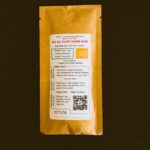
The book came accompanied by a signed bookplate, an author letter, and a little swag-travel brochure. What also came with it is a mysterious envelope that you’re supposed to open after reading. I’m super curious to see what is in there – and I hope they keep doing that in future boxes!

Candles are one of my favourite things to receive in boxes – though it is getting to the point where I pretty much have a collection. Burning them while reading gives me joy and makes my room smell great. I’m thrilled with this Inej (Six of Crows duology) inspired candle, it is beautiful and it smells AMAZING! It also comes in a solid dark glass jar, which shouldn’t make a difference, but I’m really excited about! This was designed by Get Fictional and it is probably my favourite item in this box! Though it is closely followed by the tea:
Inspired by Stephen King’s IT, this tea is intended to be drunk cold, and has been created by Story of my Tea. From the description, it is a fairly pure tea, without added flavour, so definitely something that pleases tea-purists. I really like that it contains caffeine – most teas that I’ve received in boxes have either been herbal/fruit based, or decaffeinated – and if I drink black or green tea (which I only do like every day) I want my tea to contain caffeine. Maybe that’s a grad student problem though, we do run on tea and coffee…
The next item is a Triwizard Tournament inspired bath bomb from Zen Bath Candies. I don’t know how these girls do it, but they included the three types of items I love most! I can’t wait to hang out in a hot bath and enjoy this! As it addresses the second task Harry Potter has to undergo in the Triwizard Tournament, it quite literally fits the theme of keeping your head above water!
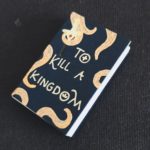
Now this item is tiny, so tiny that I actually didn’t see it when I was unpacking the box yesterday and only found it when I was taking pictures earlier! The little black thing had simply hidden in the depths of the box – or maybe I’m just silly! It is a tiny book-magnet, which you can actually write in! It’s maybe 4×2.5 cm big and ADORABLE! It has been handmade by A Magnetic Library, and the book it represents, To Kill a Kingdom by Alexandra Christo, is a tale of sirens and princes and figuring out how to interact with the world once it turns out that there is more to the story than the strict rules you have been raised by.
Now on to the papery goodies included! This wonderful Hogwarts Express print will definitely go on to my wall, and I will have to try that smoothie recipe on the back. Inspired by Draco Malfoy and his love of apples, it sounds delicious (and contains neither bananas, nor pineapples, the point of which I don’t get when it comes to smoothies).

These stickers were actually the first thing I saw when I started unpacking the box. All of them are self-care themed, and I love the idea. Sadly, they are a bit too pastel for my taste, but I’m sure I’ll be able to use at least some of them for my bullet journal. And who knows, maybe I will start liking pastels at some point!
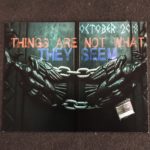
Finally, there was a self-care prompt included which focuses on gratitude. In a funny coincidence, my therapist actually told me to start a gratitude journal in our last session. I will definitely have to look into adding this to my bullet journal and figuring out the best way to do it. Being mindful and content with yourself and the people around you is central to mental hygiene in my opinion, and I hope through this more people are inspired to look at the small things that happen and not ignore them and only see the bad! Furthermore, they included a little September playlist on Spotify, which I find a great idea. However, as I’m not too fond of mainstream music, and listen mainly to metal, this isn’t really something I will enjoy.

Last but not least, the reverse of the soundtrack card reveals the October theme, Things are not what they seem – I am very much looking forward to see what they have planned around that theme!

Now that I’ve talked about everything included in the box, I assume you’re wondering whether it is worth subscribing yourself. I do recommend it, and spots are currently open for October! It is a well-curated box, supports small businesses, and focuses on mental health – I approve!
-
The Way of All Flesh – Ambrose Parry

— DISCLAIMER: I received a eARC of this novel via NetGalley – thank you to both Netgalley and Canongate Books! All opinions expressed in this review are my own. —
STAR RATING: 4/5 ✶
PUBLICATION DATE: 02/10/2018
SUMMARY: Will Raven begins his medical apprenticeship with the eminent Professor of Midwifery in Edinburgh in the mid-19th century, when he stumbles upon a series of women who have died with their bodies contorted. He suspects that there may be more than the police suspects, as these are women of lower social standing that would not usually be seen as important cases. Over the course of his investigation, he, and the house maid Sarah, become entangled in a much bigger web than expected…
OPINIONS: What I liked best about this historical crime novel is that the characters are actually human. The authors (Ambrose Parry is a pseudonym for the authorial team) kept surprising me with their multi-faceted protagonists. Both Raven and Sarah, the two central characters, are utterly understandable and have reasonable flaws. The relationships between the different characters evolve organically, which makes for a wonderful read. Through Sarah, a smart, curious house maid, they also address the social implications of being a woman, and even foreshadow the suffragette movement later in the century. As they say, it needs women willing to fight for change to instigate changes happening.
Another really cool aspect was the detailed use of the state of the medical profession in Edinburgh at the time, going into practical midwifery, but also public surgeries, and even the beginning use of anaesthesia. This is a subject I didn’t know much about beforehand, and I found it fascinating to learn more about how medicine worked and developed in a period not that far from ‘modern science’, but often perceived to be almost as dark as the Middle Ages in popular conception.
I really enjoyed the novel, and could barely put it down at times, even if the culprit of the overarching mystery was rather obvious to me – though it made sense from the characters’ point of view that it took them so long to figure out the solution. The resolution at the end was well crafted, and gave the book a nice stand-alone end (although there are going to be further novels in the series).
-
State of Sorrow – Melinda Salisbury

STAR RATING: 5/5 ✶
SUMMARY: Born immediately after her older brother tragically died, killing her mother in childbirth, Sorrow was named so, ‘for that is all she brings us.’ She grew up at the court of Rhallon, her father the chancellor, and lost in grief and drugs. After her grandmother, one of the few positive figures in her life, died, Sorrow has taken up the day-to-day running of things to cover for her father. She is poised to take over for real as the only heir, when events change everything she’s ever known.
OPINIONS: What a wonderful and surprising book! I picked up the paperback in London on a whim a few months ago, taken by the pretty cover and the fact that it was signed, without any expectations. I had been pushing out reading it since then, as the synopsis on the back made it sound like a generic fantasy novel, but randomly packed it for a week-long trip to the Scottish countryside – which is wonderful and gave us the opportunity to read so many books! Although the beginning makes you expect the usual YA fantasy tropes, this book is so much more. It is twisty and turny and unexpected, full of flawed characters trying to do their best, and it gets better continually.
It is rare that a book truly surprises me, but Melinda Salisbury manages all that and more. I couldn’t stop reading, simultaneously almost crying and loving it so much. My main point of criticism is that events escalate very quickly in the last few pages, leading to a massive cliffhanger – PLEASE SEND ME AN ARC OF BOOK TWO I NEED TO KNOW WHAT HAPPENS! It is probably one of my top five books I’ve read this year, and I have read way too many already. It is so good that I had a massive amazing-book-flash, and couldn’t really get into any books for a couple of days; I don’t remember the last time that has happened to me.
I can’t quite believe that I keep gushing so much about State of Sorrow, I’m usually much more critical of things I read. As the people who know me might know, I am currently working on writing my first novel, and this is such inspiration for implementing many of the subtler ideas I want to be part of my own story. My favourite part, if I had to choose, is probably the way Melinda Salisbury manages to work in subtle social criticism and political workings without being obvious about. She makes people think, and finely analyses how a political system works – and should work – and what makes a good leader. When to follow rules, and when to break them is also a crucial point, something Sorrow must learn: Just because people care about you and give you advice with the best intentions, doesn’t mean that they are necessarily right. Everyone is fallible in this story, and I believe that that is an important message to confer.
This book was cool enough for me to share with my friend Simon (you can see his hand in the picture above), who’s usually not really into this kind of YA fantasy novel, and he loved it too. I asked him to write down a few opinions as someone who’s more into intellectual literature and literary theory as a kind of mini-guest-blog.
SIMON’S OPINIONS:
Enthralling narrative that deviates from the usual fantasy setting in its turn towards political intrigue and a focus on the consequences of being forced into a roll by the societal norms and traditions.
Strong in its description of personal dilemmas and the way they are addressed and dealt with. The philosophical question of what makes a good leader is not a new one, however, the narrative manages to address and consequently de-familiarize its readership through the world and characters at hand, providing a critical point of view and maybe encourages to ponder the implications of leadership and democracy a bit further.
Unfortunately, the story’s last part culminates too quickly and leaves some plot-development and character intentions behind for a classical cliffhanger.
Will definitely read book two. -
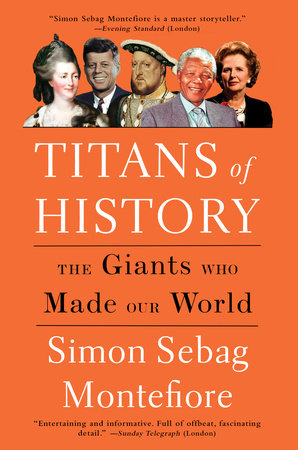
Titans of History – Simon Sebag Montefiore
— DISCLAIMER: I received a free e-arc of this book via NetGalley – thank you to NetGalley and Vintage! All opinions expressed in this review are my own. I should also add that I am a trained historian and as such will likely be biased in reviewing a history book. —
I know this blog says it reviews YA novels, but please allow me the excursion into my other passion, history, as I feel that I have important things to say about this.
STAR RATING: 2/5 ✶
ABOUT THE BOOK: In this book, Montefiore tries to assemble a group of people who shaped our world as we find it today and writes short (a few pages per person) biographies of them, and how they have influenced history. His work spans from early antiquity to the late twentieth century, with a focus on the nineteenth and twentieth centuries. I understand that this is a new edition of a work that was originally published in 2012.
OPINIONS:
When I first found out that I would be reviewing a book written by Simon Sebag Montefiore, I couldn’t contain my excitement, as back when I was a baby student and wrote my very first history paper for university, his book on Stalin and Molotov was one of my main sources and I really enjoyed it. But to be honest, I had a hard time with this book. I tried very hard to shut off my academic historian voice and keep in mind that it is intended to be a popular history book, however, I feel like some of the issues I had with it were intensified when considering that this would be read by people who might not have read anything else on this subject.
In the beginning, I felt like the choices were made well in respect to diversity, both gender and location, and I even found out about a couple of medieval women I need to read more on (sadly, women were much less prominent as the volume continued…). But as the book went on, these choices seemed more and more skewered to me. Less than half of the book is dedicated to ancient and medieval figures, leaving out many of those I believe are crucial, but so far, so good – I’m a medievalist and am biased, and most people don’t care about that time period (which is a shame!) so he might not have wanted to force it on them. However, while the Renaissance and the early modern period get slightly more attention, the last third of the book is solely 20th century. To me, that does not make much sense at all, as many of the important people of the twentieth century were resting on the shoulders of thinkers much earlier. But this issue can be put down to preference.
What makes me worry much more, is the fact that the book is incredibly western-centric. Most figures originate from Europe and North America, a bunch – maybe around 10% if we’re feeling generous – from Asia, and at most a handful for Africa and South America. In today’s xenophobic society, telling the average person that no one important came out of these large areas aids with the right’s nationalism and fear of difference. Right now, society needs a reminder that our western culture is not the only one of importance and that, in their core, humans are equal, no matter how they look or where they hail from.
A second point that worries me in respect to this being aimed at the public is the historical methodology that seems to be lacking in crucial points. There are no references – at least not in the review version I received – and there is a lack of critical commentary. This is something I especially noticed in the areas where my expertise lays – theories are presented as facts without critical analysis or any mention that they are theories. Furthermore, supposed quotes of the subjects of the chapters are taken as granted, without reference to how they made their way to us, which makes them untrustworthy. A good example for this is the medieval muslim ruler Saladin: Montefiore gives a supposed quote, but does not refer to where this originated. Given the context, I could well imagine the quote having come from a western chronicler of the crusades, intent on making his side look good. Perhaps I am overly worried by this, but I feel like such portrayals might prejudice readers, and give society a much more biased image.
And now, let’s end on a couple of ‘technical’ issues. First and foremost, the chapters were too short. Reading a Wikipedia article on the person in question might give a reader more information. Especially the earlier chapters amount only to very few pages. As I read the book on my kindle, it is hard to judge, but I feel like the later entries were much more detailed and longer than earlier ones. The second of these is that the people are organised by their year of birth. Especially in the twentieth century that makes for an interesting reading experience – Margaret Thatcher coming before Anne Frank, for example. I believe that it would have made more sense to organise the biographies by the years where a particular person had the most impact. This could easily have been done in the background and the portraits kept as they are now, making for a smoother reading experience.
A bookish nerd sharing reviews of current SFF novels